












Story By: Felix Ernest Odamtten / Mohammed Faisal Mustapha
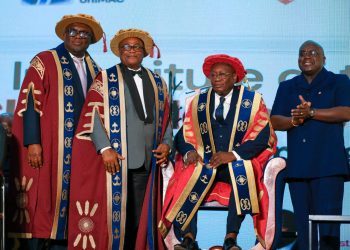
The University of Media, Arts and Communication (UniMAC) has graduated 1,414 students at the first session of its Fifth Congregation, marking a significant milestone in the institution’s academic development and strengthening its position as a leading centre for media, communication, language and creative arts education in Ghana.
The graduation ceremony brought together students from the Institute of Journalism, Institute of Languages, and Institute of Film and Television, celebrating years of academic commitment, personal sacrifice and professional preparation.
For the graduates, the occasion represented not merely the attainment of academic qualifications but the beginning of a new chapter in a rapidly transforming global environment where information, technology, creativity and innovation increasingly shape societies and economies.
Chancellor: Look Beyond Certificates
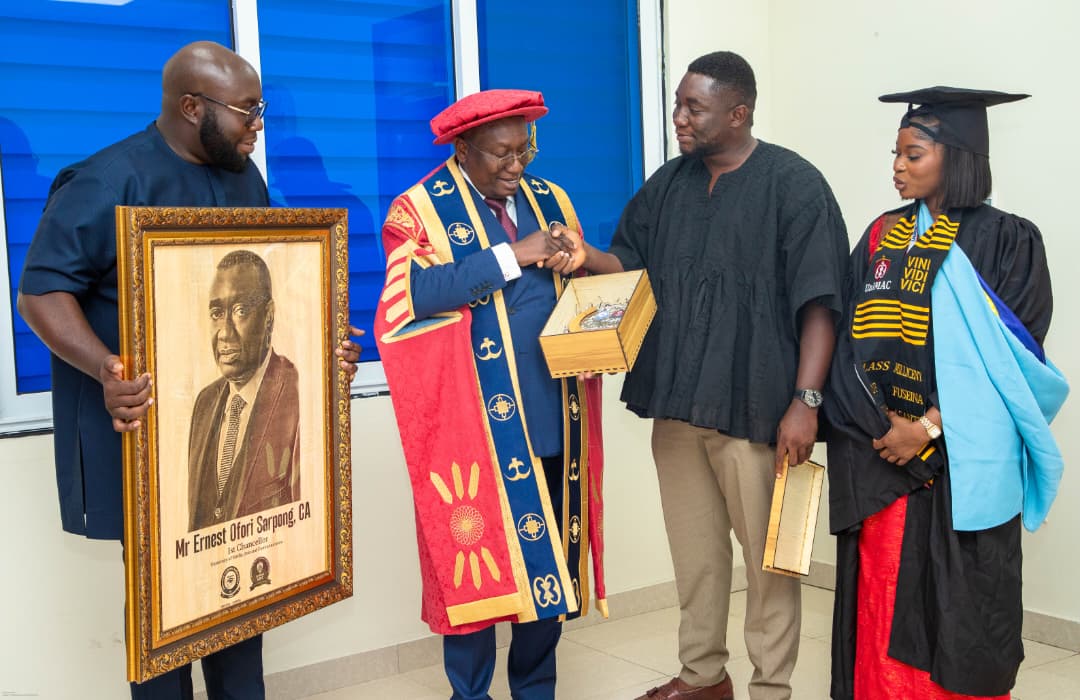
Addressing the congregation, Chancellor Dr. Ofori Sarpong observed that graduation should not be viewed simply as the conclusion of an academic journey but as the beginning of a lifelong commitment to excellence, integrity and service.
According to him, the true standing of a university must be assessed beyond the number of certificates it awards, taking into consideration the quality of its graduates, the relevance of its research and its contribution to national and global development.
“The true measure of a university lies not only in the qualifications it awards, but in the quality of its graduates and its contribution to society.”
He particularly challenged the graduates not to allow their certificates to become the limits of their ambitions, encouraging them to embrace continuous learning, research, critical thinking and professional development.
“Your certificate should not become the limit of your ambition; let it become the foundation of your greatest achievements.”
He urged them to create trends rather than merely follow them, understand audiences instead of chasing algorithms, and establish themselves as voices of substance in an information environment increasingly crowded by competing narratives.
“Create trends rather than merely follow them; understand audiences instead of chasing algorithms, and become voices of substance rather than noise.”
AI and the Future of Storytelling
Addressing the rapidly changing landscape of journalism, communication and the creative industries, the Chancellor highlighted the growing influence of artificial intelligence and emerging technologies, noting that the future would increasingly reward professionals capable of combining technological competence with human intelligence, ethical judgment and originality.
“Technology may transform storytelling, but human imagination, ethical judgment and cultural understanding must remain at the heart of communication.”
57.6% Growth in Graduates
Providing an overview of the graduating class, Vice Chancellor Prof. Eric Opoku-Mensah disclosed that the 1,414 graduates represented a remarkable 57.6 per cent increase over the 897 students who graduated in the previous year.
He described the growth as an indication of the university’s expanding appeal and the increasing demand for specialised education in journalism, communication, languages and the creative arts.
The gender distribution also highlighted the significant participation of women in higher education, with females constituting 1,059 of the graduates, representing approximately 74.9 per cent, while males accounted for 355, or 25.1 per cent.
In terms of academic performance, the university recorded 200 First Class Honours graduates, 699 Second Class Upper, 372 Second Class Lower, 115 Third Class and 28 Pass graduates.
Students Shine Beyond the Classroom
Highlighting the achievements of students beyond the classroom, Prof. Opoku-Mensah announced that two UniMAC students, Titus Owusu-Daakun and Precious Akuokisa Akun, had won the 2026 Commonwealth Parliamentary Association National Debate Competition organised at Ghana’s Parliament House.
Their victory earned them the opportunity to represent Ghana at the international competition in Sydney, Australia, demonstrating the university’s growing contribution to public discourse, critical reasoning and intellectual engagement.
Another major institutional achievement was the organisation of UniMAC’s first international State of Journalism, Media and Communication Conference, which assembled scholars, researchers, media practitioners and other stakeholders to examine the challenges and opportunities confronting contemporary journalism and communication.
Discussions addressed critical issues including artificial intelligence, disinformation, media ownership and the future of journalism education, reinforcing the university’s ambition to contribute to international research and policy conversations.
Challenges and the Way Forward
Nevertheless, Prof. Opoku-Mensah acknowledged that the institution continued to face challenges relating to infrastructure, funding, technological advancement and the rapidly changing demands of the media and creative industries.
He expressed confidence that these constraints could be addressed through strategic planning, stronger partnerships, effective resource management and sustained investment in institutional development.
More Than a Milestone
Ultimately, the congregation represented more than an academic milestone for UniMAC. It highlighted the growing importance of professional media education at a time when journalism, communication, indigenous languages and creative expression are central to democratic accountability, cultural preservation, economic development and international engagement.
As the 1,414 graduates prepare to enter their respective professions, the expectations placed on them extend beyond academic distinction to ethical leadership, innovation and service.
The challenge issued by Dr. Ofori Sarpong and reinforced by the Vice Chancellor was clear: the future of Ghana’s media and creative industries will depend not simply on technological advancement, but on the quality, character, courage and vision of the people entrusted with shaping it.