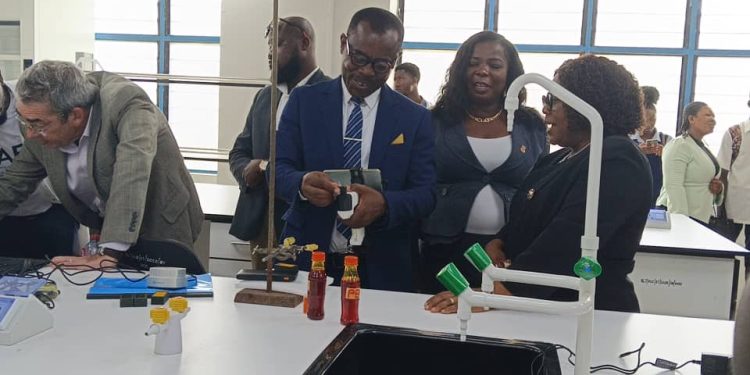
The University of Cape Coast (UCC) is developing artificial intelligence-powered technologies to detect food adulteration and verify product quality in real-time as part of efforts to tackle food fraud in Ghana and across Africa.
The initiative is being spearheaded by the newly inaugurated Africa Centre for Food Integrity (AFIC), established by UCC’s College of Agriculture and Natural Sciences (CANS) to strengthen food safety, protect consumers and improve confidence in food production and trade.
The centre is developing mobile-enabled technologies capable of assessing food quality by mimicking the five human senses — sight, smell, taste, touch and hearing.
The technologies are expected to help identify harmful substances and deliberate adulteration in food products, including palm oil, spices and other commonly consumed items.
Speaking at the inauguration, the Centre Lead and Agri-Food Integrity expert, Reverend Professor Ernest Teye, said the initiative was conceived about nine years ago in response to growing concerns over food contamination, adulteration and fraud in parts of Africa.
He explained that conventional food-testing methods were often cumbersome and time-consuming, making it difficult to detect and address food fraud promptly.
However, the centre has developed a mobile-enabled spectroscopic device that can assess the safety and quality of palm oil within seconds, a process that traditionally takes several days or weeks.
Prof. Teye also announced that AFIC had developed a cocoa passport system designed to trace cocoa beans to their places of production.
The centre is additionally preparing to introduce Spice Check, a technology that will authenticate spices sold and consumed in Ghana.
Food fraud, which involves the deliberate adulteration or misrepresentation of food for financial gain, remains a concern in Ghana.
Some reported practices include the addition of Sudan IV dye to palm oil, mixing ginger powder with sawdust, combining cola nuts with powdered pepper and adding flour to groundnut paste while marketing the products as pure or organic.
To address these challenges, AFIC plans to collaborate with key institutions, including the Food and Drugs Authority (FDA), the Ghana Standards Authority, farmers and other universities.
Beyond technological innovation, the centre will undertake public education to help consumers identify food fraud and understand the importance of checking product labels and verifying food safety.
Prof. Teye said the ultimate objective was to ensure that food consumed by the public was safe, authentic and sustainable.
He emphasised that sustainable food systems were fundamental to achieving broader development objectives, noting that food security and integrity underpin all the Sustainable Development Goals (SDGs).
“All the Sustainable Development Goals (SDGs) will go nowhere if we cannot have a sustainable food system because food is the foundation of every SDG and so we must look at food first,” he stressed.