








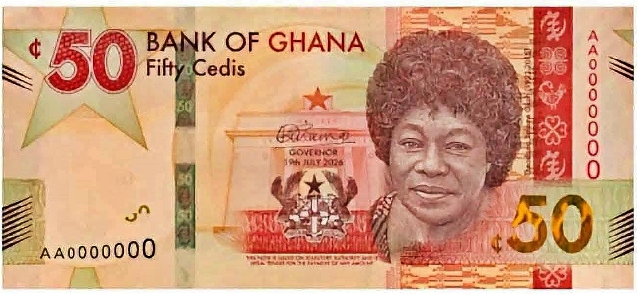
The Bank of Ghana (BoG) is facing questions over the portrait of Ghana’s national flag designer, Theodosia Salome Okoh, featured on the newly unveiled GH¢50 banknote, after a family member claimed the image belongs to his mother.
Dr Eddie Obeng, a nephew of Theodosia Okoh, has challenged the accuracy of the portrait, insisting that the woman depicted on the new currency bears a striking resemblance to his mother, Dr Letitia Obeng, rather than his aunt.
The controversy has triggered widespread discussion on social media, putting the Bank of Ghana’s verification process under scrutiny barely a day after the unveiling of the new Heritage Series banknotes.
In a LinkedIn post accompanied by images of the new GH¢50 note, Dr Obeng said he was initially excited to learn that his aunt had been honoured for her contribution to Ghana’s history.
However, his excitement turned to surprise when he examined the portrait and concluded that the image used was that of his mother, Ghana’s first female scientist and the country’s first woman to obtain a PhD.
“I have a wry smile on my face that won’t go away, and occasionally I shake my head or giggle. So, I heard this morning that my aunt had been honoured in a new series of issued banknotes in Ghana – she’s famous there for designing the country’s flag after independence from Britain. I was very proud and began composing a message to my cousin,” he wrote.
“Imagine my surprise when I took a look and realised that they have used a picture of my mother instead – she’s famous for being the country’s first lady PhD. You can’t make it up,” he added.
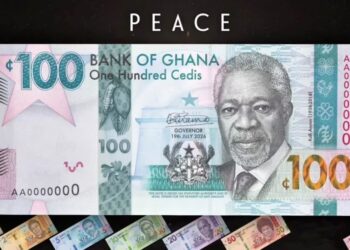
The GH¢50 note forms part of the new Heritage Series unveiled by President John Dramani Mahama and Bank of Ghana Governor Dr Johnson Asiama in Accra on Thursday, November 12, 2026.
The controversy has also attracted criticism from Minority Leader Alexander Afenyo-Markin, who accused the government of rushing the currency redesign at the expense of accuracy and proper recognition of Ghana’s historical figures.
He linked the alleged error to what he described as an attempt to remove the Big Six from the country’s currency and national history.
“In fact, they were in haste to erase the Big Six from our currency and our history. Out of that haste and hate, we saw them adorning a new fifty-cedi note bearing the name of Theodosia Okoh but they got her picture wrong,” he said.
However, Presidential Staffer and Bank of Ghana Board member Beatrice Annan has defended the portrait, explaining that it was an artistic engraving developed from three authentic photographs of Theodosia Okoh.
In a Facebook post, she said the image was not intended to be an ordinary photographic reproduction but an artistic rendering designed to meet the technical and security requirements of banknote production.
According to her, the Bank worked with two photographs of Okoh from her younger years and another from her later life to develop a single portrait depicting her as a mature woman.
She added that adjustments were made to her hairstyle to achieve a clear outline suitable for engraving while maintaining a faithful family resemblance.
Beatrice Annan further disclosed that the Bank was engaging members of Theodosia Okoh’s family to explain the process behind the portrait and address their concerns.
The Bank of Ghana has yet to issue an official statement directly addressing the family’s allegation or independently clarifying the controversy surrounding the portrait.
The dispute has raised questions about the verification process used in selecting historical figures and their representations on the new currency, which is expected to enter circulation on December 1, 2026.