







Every new banknote of our soon-to-be-70 beloved country will carry the name Ghana. Yet the man whose research and advocacy helped secure that name has been denied a place on any denomination of the new Heritage Series. In fact, he has been completely obliterated.
That is the uncomfortable contradiction President John Dramani Mahama and Bank of Ghana Governor Dr Johnson Asiama must explain.
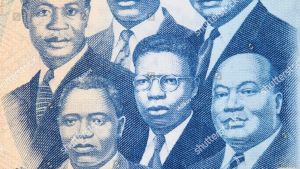
As Ghana approaches its 70th independence anniversary, the government has unveiled banknotes celebrating our national heritage while removing the collective portrait of the Big Six, namely,. Nkrumah remains, individually honoured on the GH¢200 note. The other five disappear from the new series entirely. The existing notes will circulate alongside the new ones, but the direction of the redesign is unmistakable.
Was there really no room, on even one denomination, for the Big Six together,? The question deserves an answer beyond the familiar partisan reflex that anyone defending Danquah must somehow be diminishing Nkrumah.
Since the previous 2007 redenomination, the collective portrait of the Big Six provided the principal human image on Ghana’s ordinary banknote series. All five denominations introduced in 2007 carried it. Under President John Evans Atta Mills, the GH¢2 note introduced in 2010 honoured Nkrumah individually. A commemorative GH¢5 note featuring James Kwegyir Aggrey followed in 2017. Those additions demonstrated that Ghana could broaden recognition without abolishing the collective tribute to the independence struggle.
The Big Six portrait never needed to mean that only six people fought for independence. It represented a historic turning point in a struggle involving chiefs, traders, farmers, workers, women, veterans and many other patriots.
The government could have, at least, retained that symbol on one note while using the remaining denominations to honour other distinguished Ghanaians. Instead, the collective recognition has been removed altogether. That choice carries a political message, whatever its designers intended, and their intentions appear loud enough.
Consider the history behind the portrait. The United Gold Coast Convention, the first political party set up deliberately to achieve self-rule, was set up on 4 August 1947. On 29 December 1947, Nkrumah was confirmed as General Secretary. On 20 February 1948, Danquah and Nkrumah addressed ex-servicemen at the Palladium Cinema in Accra. Their involvement in the political mobilisation surrounding the veterans’ grievances preceded the shootings of 28 February. They were key participants in the agitation, not names attached to it retrospectively.
The veterans organised their own march. Nii Kwabena Bonne III led the distinct boycott of imported goods. These contributions deserve their full place in the national story. So does the UGCC leadership’s intervention when the shootings and subsequent disturbances exposed the depth of popular anger.
The colonial authorities believed the UGCC leaders had orchestrated the unrest and detained the six men subsequently known as the Big Six. That suspicion does not mean they planned the violence. The Watson Commission’s investigation revealed grievances far wider at the time, including economic hardship, racial discrimination, unemployment and frustration with colonial government. It also examined the UGCC’s activities and the nationalist demands surrounding the crisis.
The Six were therefore not accidental spectators to the decisive events of the time. Their response to the crisis was political and consequential. The UGCC cable to the Secretary of State, penned by Danquah, demanded immediate governmental change and offered to assume responsibility for an interim administration. Alongside that cable, Danquah issued his public appeal to the chiefs and people, published in the African Morning Post on 3 March 1948 and reproduced in contemporary reporting: “Nananom and people, it is our view that the hour of liberation has struck.” He addressed them as: “Inheritors of Ghana’s ancient kingdom.”
Here was Danquah publicly invoking Ghana in the immediate aftermath of the disturbances, nine years before independence. This is contemporary evidence, preserved in a newspaper of the period. It exposes the weakness of the attempt to reduce Danquah to an inconvenient ancestor of today’s NPP.
In his letter to Nkrumah dated 30 April 1957, correcting passages in Nkrumah’s autobiography, Danquah traced his identification of the name to research in 1928. He said it had been: “put forward by me in 1944 for adoption by the Gold Coast when liberated.”
In the same letter, recalling discussions during the detention of the Big Six in Kumasi in 1948, Danquah stated: “We agreed [there] upon the name Ghana.” He also challenged the autobiography’s failure to acknowledge his contribution. This was a claim made directly to Nkrumah, while other participants were alive and able to contest the recollection.
A historian must distinguish a participant’s recollection from independently established fact. But Danquah’s account cannot simply be waved away as a story invented by his political descendants. His early writings and public advocacy provide evidence of a campaign that preceded independence by many years. The Encyclopaedia Africana, published in 1977, 20 years after Independence and 15 years before the NPP was formed, expressly connects Danquah’s historical research with the eventual adoption of Ghana as the country’s name. Scholars may dispute aspects of his migration theory. But we are united in recognising the political influence of his advocacy.
The chronology of Ghana National College, my own alma mater, is also instructive. Nkrumah founded the school in July 1948, while still General Secretary of the UGCC. The CPP came into existence in June 1949. The school therefore bore the name Ghana before the political rupture between Nkrumah and his former colleagues. Their subsequent rivalry did not prevent the name from becoming the country’s shared national identity.
It is noteworthy that prior to the school’s founding in July, Danquah suggested in paragraph 3 of his proposal to the Watson Commission, ‘A Basic Constitution for Ghanaland’, in April 1948 for the substantive name of the country, Ghana, to be adopted in place of the ‘colonial adjective’, Gold Coast, as the first act of the constitution-making body.
By Isaac Tetteh Opandoh, Researcher at Danquah Institute