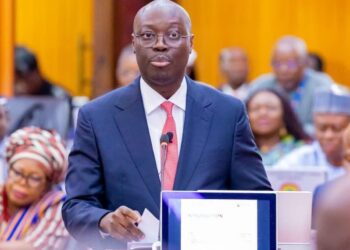

















The Minority in Parliament has questioned the economic impact of the government’s proposed US$10 billion economic transformation programme, arguing that its projected contribution to growth falls short of expectations.
The caucus says the government’s 2027 real GDP growth target of 5.2 per cent raises concerns about the programme’s ability to accelerate economic expansion and create meaningful employment opportunities.
Dr Amin Adam, Ranking Member on Parliament’s Finance Committee and MP for Karaga, said the projected growth rate represents an increase of only 0.3 percentage points over the economy’s baseline growth of 4.9 per cent.
Speaking on behalf of the Minority during the debate on the 2027 Budget presented by Finance Minister Dr Cassiel Ato Forson, he questioned whether such a marginal improvement justified the scale of the proposed economic transformation initiative.
“Because if the baseline is 4.9% and you are projected to grow at 5.2%, you are simply saying that with this huge, ambitious New Economy programme, it can only add 0.3 percentage points to the growth for 2027. This is not realistic,” he said.
Dr Adam maintained that the growth projection was also inadequate to address the country’s unemployment challenge, particularly among young people who expect stronger economic expansion to translate into jobs.
“It does not offer hope, as this paltry growth cannot provide the jobs the young people are looking for from this government,” he added.
Beyond the 2027 projections, the Minority raised concerns about what it described as a slowdown in economic growth, citing figures showing a decline in real GDP growth from 6.4 per cent in the first half of 2025 to 6.2 per cent in the corresponding period of 2026.
The caucus also pointed to a sharper decline in non-oil GDP growth, which reportedly fell from 8.2 per cent to 5.9 per cent over the same period.
According to Dr Adam, the performance of the non-oil sector is particularly significant because sectors such as agriculture and manufacturing have considerable potential to generate employment.
He argued that the decline undermined the government’s claims of strong economic performance and questioned the Finance Minister’s celebration of the figures in Parliament.
“Non-oil growth is where the jobs are created, i.e. manufacturing, agriculture, etc. And if it can slide from the previous year’s 8.2% in the first half of 2025 to 5.9% in the first half of 2026, it simply tells you that this economy is not growing; it is sliding,” he said.
He further described the government’s assessment of the economy as misplaced, accusing Dr Forson of presenting underwhelming growth figures as an achievement.
“And this minister had no right to stand on the floor of Parliament and celebrate this as success. This is mediocrity at its best,” he said.
The government is targeting real GDP growth of at least 5.2 per cent in 2027 under its broader economic policy and transformation agenda.