

















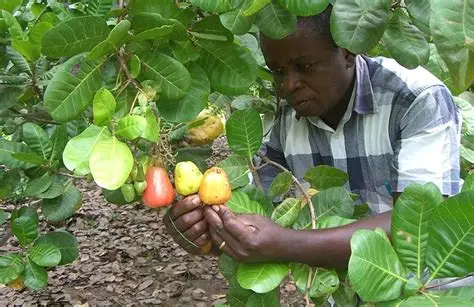
Cashew farmers in Ghana have warned that a ban on raw cashew exports could leave more than 200,000 metric tonnes of the country’s annual production without ready buyers unless local processing capacity is significantly expanded.
The Ghana Cooperative Cashew Farmers and Marketing Association says existing factories cannot absorb the volume produced annually and has urged the government to increase processing capacity before enforcing the proposed export restriction.
The association’s Vice-President, Daniel Takyi, said farmers supported local value addition but insisted that adequate processing facilities must be in place to protect their livelihoods.
Speaking in an interview on Friday, November 27, 2026, he said Ghana produces approximately 262,000 metric tonnes of raw cashew nuts annually, while existing processing facilities can handle only a fraction of that volume.
He disclosed that current factories have a combined processing capacity of about 17,000 metric tonnes, with a new facility in Techiman expected to add another 30,000 metric tonnes.
This would bring local processing capacity to approximately 47,000 metric tonnes, still significantly below annual production.
Takyi questioned how farmers would sell the remaining produce if exports were restricted before additional factories were established.
“If we say because of 50,000 metric tonnes we shouldn’t export, what will happen to the remainder of 262,000 we produce?” he asked.
He said the association was taking steps to establish its own processing plant after the Wenchi Manhene and his elders allocated land for the proposed facility.
According to him, farmers would fully support the export ban when local processors had the capacity to absorb at least 75 per cent of the country’s cashew production.
Farmers face storage and labour challenges
Takyi also highlighted the difficulties farmers would face if they were compelled to store their produce while waiting for local buyers.
He explained that January to March was the peak harvesting period, when cashew nuts were generally of the best quality, but quality deteriorated after the onset of the rains.
He added that inadequate storage facilities and the need to pay farm labourers daily made it difficult for farmers to hold on to harvested nuts for extended periods.
“If they work for two days and you don’t pay them, they won’t come again,” he said.
He warned that uncertainty over the proposed export restrictions could also discourage foreign buyers and push them towards alternative markets.
The association is therefore appealing to the government to address the processing and storage gaps before implementing the restriction, particularly as farmers prepare for the new harvesting season.