













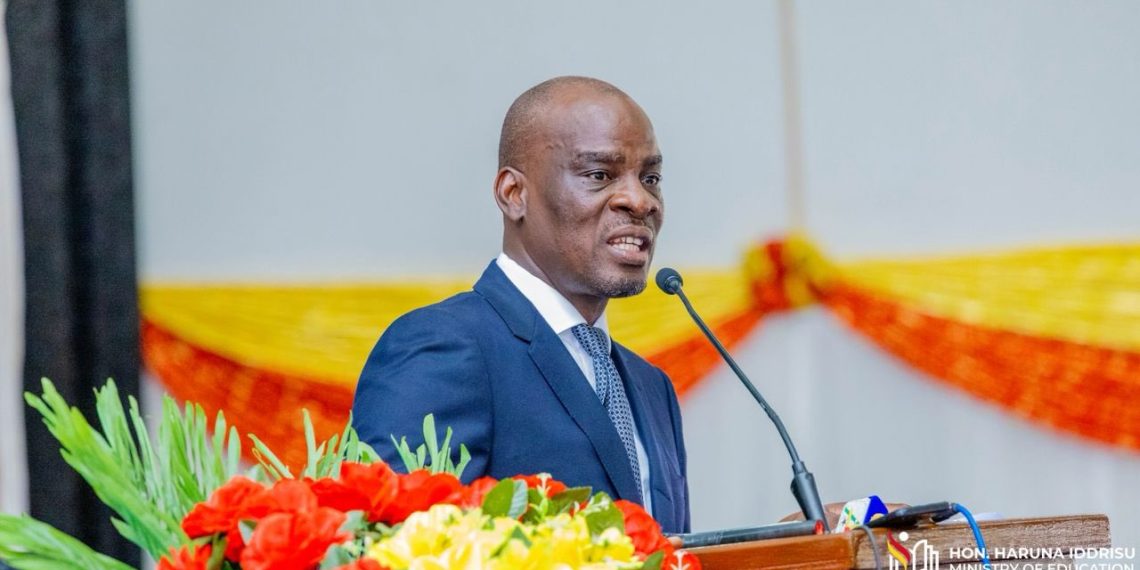
Pupils in Junior High School (JHS) 2 and below who attempt to sit the Basic Education Certificate Examination (BECE) ahead of schedule will face a two-year examination ban, Education Minister Haruna Iddrisu has announced.
The immediate directive is intended to stop parents from pushing their children to complete basic education earlier than their peers, a practice the Minister says undermines fairness and effective education planning.
Speaking at the opening of the 2026 National Education Week on Monday, November 23, Mr Iddrisu instructed the Director-General of the Ghana Education Service (GES) to communicate the decision to all regional directors and headteachers for immediate implementation.
“Some parents want to force their children to go ahead of others. That is not equity,” he said.
The Minister explained that allowing younger pupils to take the BECE prematurely distorts enrolment and completion figures used by education authorities to plan for each academic year.
He said enforcing the examination age and progression requirements would promote discipline and provide more reliable data on the number of pupils expected to complete basic education annually.
$300m Secondary School Expansion
Beyond the examination directive, Mr Iddrisu announced that government would begin the procurement process for a $300 million World Bank-supported secondary education expansion project this week.
He said the Ministry of Education would advertise the project by Friday, with the competitive procurement process expected to ensure value for money.
The project will involve constructing 10 new model schools, upgrading 20 Category B schools to Category A and moving another 30 Category C schools to Category B.
10,000 Recruitment Opportunities in 2027
The Minister also disclosed that the 2027 Budget had made provision for 10,000 recruitment opportunities covering teachers, non-teaching personnel and some academic staff of universities.
Although he did not provide a breakdown of the positions, he said the planned recruitment would create additional employment opportunities across the education sector.
AI Will Not Replace Teachers
On the integration of artificial intelligence into education, Mr Iddrisu assured teachers that government had no plans to replace them with AI technology.
“We are not going to replace teachers with AI,” he stressed, explaining that the technology would instead serve as a tool to strengthen teaching and learning, particularly in character development, independent thinking and problem-solving.
However, he cautioned that the adoption of AI must be guided by ethical considerations to prevent the technology from undermining creativity and independent thought.
Citing an OECD assessment, he said 14 per cent of existing jobs could disappear through automation within the next 15 to 20 years, while another 32 per cent could undergo significant changes.
He also raised concerns about the digital infrastructure gap in Ghanaian schools, warning that inadequate electricity and internet connectivity could prevent disadvantaged schools from benefiting from AI-driven education.
According to him, a 2023 UNESCO assessment of Ghana’s AI readiness found that only about 15 per cent of primary schools had internet access for teaching, compared with approximately 40 per cent of senior high schools.
He further revealed that the revised kindergarten to Primary Six curriculum, currently awaiting Cabinet approval, would introduce pupils to robotics, coding, artificial intelligence and electronics at an early age.
Iddrisu Defends GTEC Doctoral Audit
Meanwhile, the Minister defended the Ghana Tertiary Education Commission’s (GTEC) ongoing audit of doctoral programmes, dismissing concerns surrounding the exercise.
He explained that the audit was intended to establish the number of people who had received doctoral training, the institutions responsible for their training and their respective areas of specialisation.
The exercise would also help determine whether doctoral programmes offered by tertiary institutions were aligned with Ghana’s national development priorities.
“It is not a ban into perpetuity,” he said, insisting that the focus should be on producing quality doctoral graduates rather than simply increasing numbers.
Mr Iddrisu maintained that the various interventions formed part of efforts to improve standards, expand educational opportunities and prepare Ghana’s education system for emerging technological and workforce demands.