













African countries have intensified pressure on wealthy nations at the COP31 climate summit in Turkey, demanding stronger financial commitments to help vulnerable economies adapt to climate change as negotiations remain deadlocked over a proposed global climate agreement.
The African Group of Negotiators, led by Ghana’s Environment Minister, Zanetor Agyeman-Rawlings, has rejected what it considers inadequate commitments to climate adaptation financing, insisting that developing countries must receive the resources needed to address the consequences of climate change.
The disagreement has become one of the major obstacles to reaching consensus at the summit in Antalya, where negotiations have extended beyond their scheduled Friday conclusion.
Earlier drafts of the proposed agreement included plans to increase adaptation financing to US$120 billion by 2035. However, the target was subsequently removed, triggering strong objections from developing countries, particularly across Africa.
Addressing the negotiations, Ms Agyeman-Rawlings challenged developed nations to honour their financial responsibilities towards countries bearing the greatest consequences of global warming.
“We did not come here to beg. We came here to claim what is rightfully ours for our people who are suffering the brunt of anthropogenic activities of developed countries,” she declared.
Fossil fuel disagreement deepens deadlock
Beyond climate financing, the proposed agreement has encountered resistance over the exclusion of explicit commitments to reduce dependence on fossil fuels.
A group of countries led by France and Panama has opposed the latest draft, which makes no reference to transitioning away from oil, gas and coal.
The countries argue that any meaningful global climate agreement must contain clear commitments towards reducing fossil fuel consumption.
Panama’s Environment Minister, Juan Carlos Navarro, said his country would not accept an agreement that completely ignored the role of fossil fuels in driving climate change.
“It is not acceptable to have a COP or a cover decision that does not even mention fossil fuels and we simply will not put up with it,” he said.
France’s Minister of Ecological Transition, Monique Barbut, also criticised references to carbon capture, utilisation and storage technology in the proposed agreement, warning that such provisions could allow countries to continue burning fossil fuels without sufficiently reducing emissions.
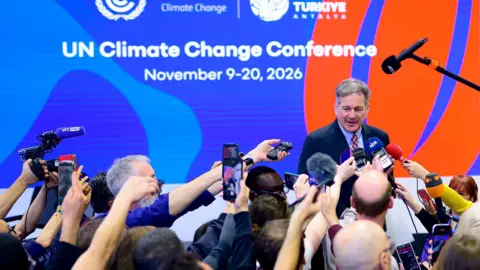
However, Australian Climate Change and Energy Minister Chris Bowen, who is leading the negotiations, argued that the summit should concentrate on implementing existing commitments and accelerating the transition towards cleaner energy sources.
The disagreement has left nearly 200 countries struggling to find common ground as negotiations continue beyond the official closing date.
1.5°C target increasingly difficult
The negotiations are taking place against growing scientific concerns that global warming will exceed the 1.5°C threshold established under the Paris Agreement.
For the first time at a COP summit, the proposed Antalya Accords acknowledge that the world has missed the target and is entering a period known as climate overshoot.
Scientists have warned that exceeding the threshold could expose millions more people to extreme heat, rising sea levels and other severe climate-related impacts.
The draft agreement also proposes greater deployment of carbon removal technologies, although their inclusion has generated disagreement among countries concerned about the possibility of using such technologies to justify continued fossil fuel production.
Growing frustration over negotiations
The prolonged negotiations have attracted criticism from environmental organisations and climate campaigners, who say governments are failing to translate climate commitments into meaningful action.
Mohamed Adow of Power Shift Africa described the summit as the worst COP meeting he had witnessed, reflecting frustration among advocacy groups over the lack of progress on their priorities.
The hosting arrangements have also attracted criticism, with some observers accusing Turkey’s negotiating leadership of mishandling crucial discussions and leaving several countries feeling sidelined.
As negotiations continue into Saturday, November 21, countries face increasing pressure to resolve the disagreements over fossil fuels and climate finance before the summit concludes without a comprehensive agreement.
The outcome is particularly significant for African countries, which continue to demand predictable financial support to strengthen climate resilience, protect vulnerable communities and address the growing economic consequences of global warming.
The latest reports confirm that the negotiations extended into Saturday, with fossil fuels and adaptation financing remaining the principal sticking points.