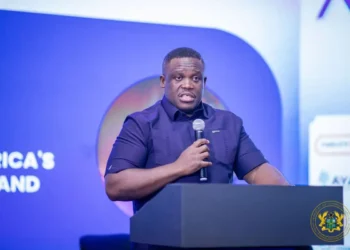
Ghana’s Minister of Communication, Digital Technology and Innovations, Samuel Nartey George, has put the spotlight on the Next Generation Infrastructure Company (NGIC), insisting that the firm must meet its latest deadline of June 2025 to roll out 5G in the country—despite emerging regulatory hurdles.
Speaking on The Point of View with Bernard Avle on Channel1 TV, the Minister acknowledged that NGIC had previously shifted its launch timelines multiple times—from December 2024 to January 2025, and now to June 2025. However, he made it clear that the government expects results this time around.
“They gave me June. I didn’t force them. So we’re going to hold them to that,” Sam George stated.
Despite NGIC’s public commitments and infrastructure readiness, new reports suggest that delays at the regulatory level—particularly from the National Communications Authority (NCA)—are now impeding progress. Key unresolved issues include:
- Spectrum interference challenges
- Approval for testing with 1,000 SIMs and a designated Public Land Mobile Network (PLMN)
- Lack of clarity on how ISPs can connect to NGIC’s infrastructure
- Final certification for the network operations centre and data facilities
Industry insiders say these bottlenecks are interdependent and could undermine NGIC’s ability to deliver a secure, stable, and high-speed network across the country.
The Minister disclosed that NGIC has completed at least 16 5G-ready cell sites, with a commitment to roll out 350 by June—mostly in Accra and Kumasi. However, he also raised concern about the state of preparedness among telcos, especially AT Ghana, whose core network and billing systems are currently incapable of supporting anything beyond 3G.
“AT Ghana’s system is in an end-of-life state. They can’t jump to 5G now. So we’re considering some sort of quasi-network for them,” he said.
This revelation points to a deeper issue: while infrastructure is being laid, some players in the telecom ecosystem may not yet be ready to harness the capabilities of 5G.
Sam George also addressed a critical misconception around 5G. Contrary to public excitement, he noted that 5G is not primarily intended for consumer streaming or mobile usage, but rather for industry-specific applications such as telemedicine, port operations, and offshore drilling.
“If we don’t fix basic network issues and rush into 5G, it’ll be a waste,” he warned, pointing to the broader need for systemic readiness across industries.
When asked what actions the government might take if NGIC fails to meet the June deadline, the Minister was cautious but firm.
“I’m not quick to terminate contracts because of the financial impact on the state,” he said. “But if we get to June and nothing has changed, we’ll consider renegotiating the licensing conditions—and all options will be on the table.”
NGIC holds a 10-year exclusive license to deploy 4G and 5G in Ghana through 2034. But with mounting public pressure and regulatory challenges slowing progress, the company now finds itself at a crossroads.
The coming weeks will be crucial for the fate of Ghana’s digital future. With NGIC, telcos, ISPs, and the NCA all needing to align quickly, failure to meet the June deadline could trigger a shake-up in the country’s approach to next-gen connectivity.
As Sam George put it: “No one can hold the country to ransom forever.”