
















Former South African President Thabo Mbeki has pushed back against growing anti-immigrant sentiment in South Africa, arguing that migrants are being unfairly blamed for economic problems that stem from deeper structural and policy failures.
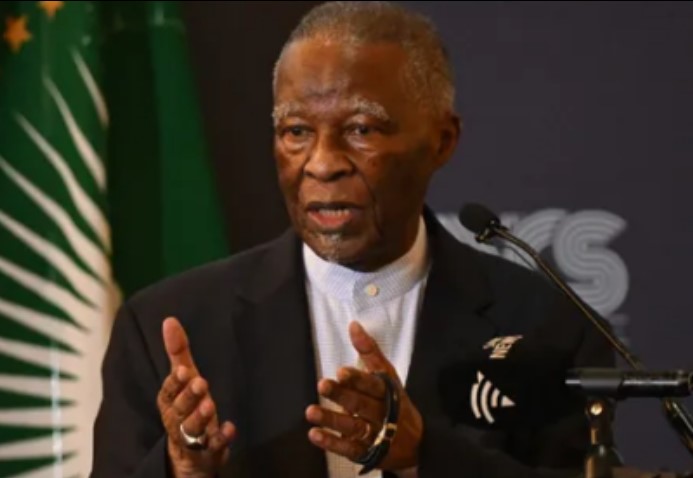
Speaking at the Thabo Mbeki Foundation and AUDA-NEPAD Business Breakfast, Mbeki challenged claims that undocumented African migrants are responsible for the country’s high unemployment and crime rates, insisting that such accusations divert attention from the real causes of South Africa’s economic difficulties.
According to him, unemployment and economic decline have been driven by factors unrelated to migration, and focusing public frustration on foreign nationals does little to address the underlying issues affecting the country.
Mbeki said South Africa once experienced strong economic growth in the years following the end of apartheid, but the subsequent slowdown and economic setbacks cannot be attributed to undocumented migrants.
He argued that those responsible for the country’s economic decline have largely escaped accountability because public attention has been redirected toward vulnerable migrant communities.
“The levels of high unemployment in this country are not due to undocumented Africans,” he stated, warning that scapegoating migrants would not solve the nation’s economic challenges.
His comments come amid renewed debate over immigration in South Africa following recent anti-immigrant demonstrations and growing concerns among foreign nationals. The discussion has gained further attention after nearly 300 Ghanaians voluntarily returned home from South Africa amid fears about their safety and wellbeing.
Mbeki predicted that migration into South Africa would continue regardless of political pressure or hostile rhetoric, noting that migration is a complex reality that requires practical management rather than emotional responses.
He urged policymakers and citizens alike to focus on identifying and addressing the actual drivers of unemployment, poverty, and economic stagnation instead of directing blame toward migrants.
The former president also called for a renewed appreciation of the historical relationship between South Africa and the rest of the African continent, reminding citizens of the solidarity many African countries extended to South Africans during the struggle against apartheid.
According to him, that shared history should serve as a foundation for cooperation rather than division.
Mbeki stressed that tackling South Africa’s economic problems will require honest conversations about governance, economic policy, and job creation, rather than what he described as misplaced attacks on foreign nationals.
He concluded by urging South Africans to confront the real causes of their economic hardships and reject narratives that portray migrants as the source of challenges that have much deeper roots.






