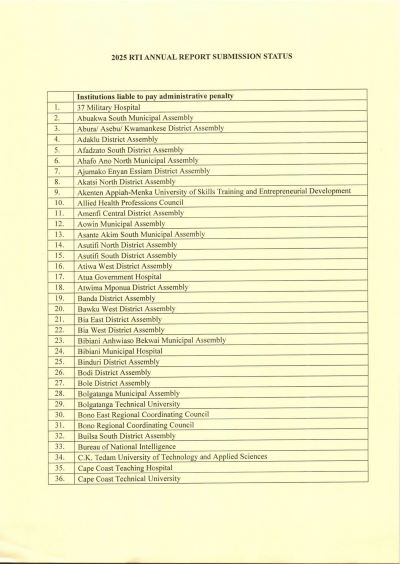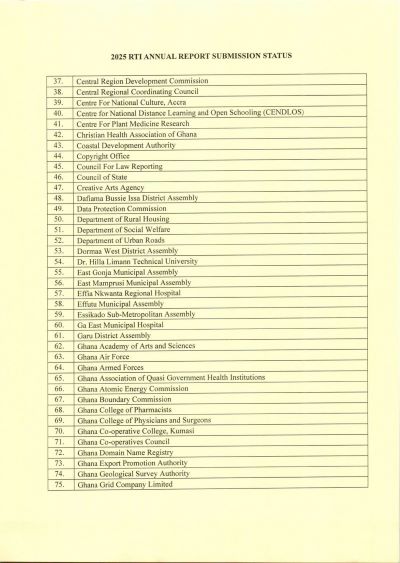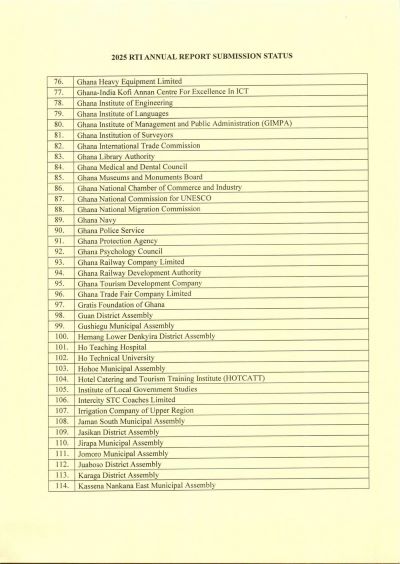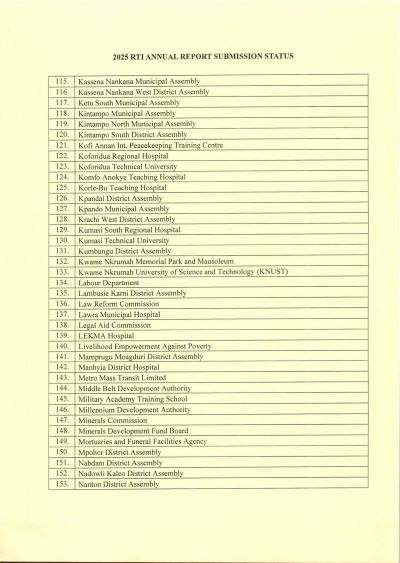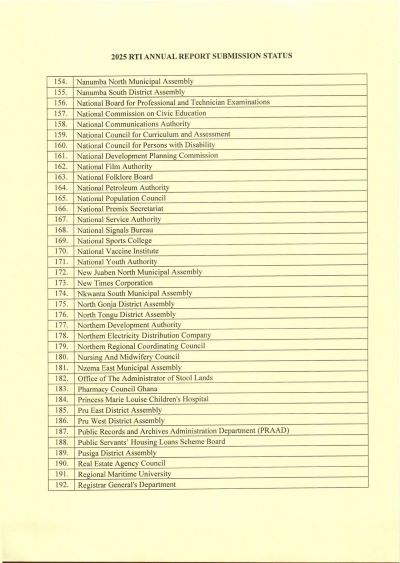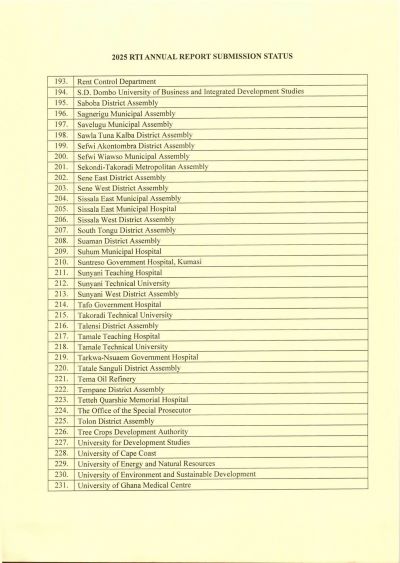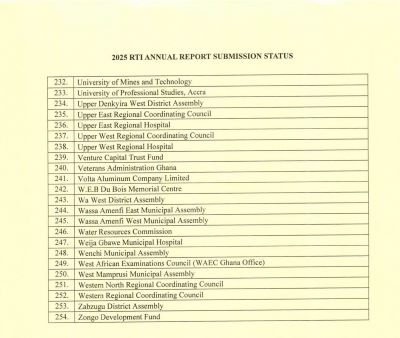
The Right to Information (RTI) Commission has sanctioned about 254 public institutions with administrative penalties of GH¢20,000 each for failing to submit their 2025 RTI Annual Reports, in what marks one of the Commission’s strongest enforcement actions under the Right to Information Act.
The affected institutions include Ministries, Departments and Agencies (MDAs) as well as Metropolitan, Municipal and District Assemblies (MMDAs), which the Commission said failed to comply with their statutory reporting obligations despite repeated reminders.
In a statement issued on Wednesday, August 5, 2026, the Commission said the penalties were imposed under Section 77(1) of the Right to Information Act, 2019 (Act 989), which requires public institutions to submit annual reports on the implementation of the RTI law.
According to the Commission, reminders were published in the Ghanaian Times on January 20, 2026, and the Daily Graphic on April 24, 2026, but many institutions still failed to submit their reports.
The Commission explained that the annual reports are essential for the preparation of its consolidated Annual Report to Parliament and form a key part of monitoring compliance with the RTI law across the public sector.
It noted that the deadline for compiling and submitting the consolidated 2025 report has already passed, making enforcement action necessary against institutions that defaulted on their legal obligations.
The RTI Commission has instructed all affected institutions to pay the GH¢20,000 administrative penalty within 14 days of receiving formal notification.
It warned that institutions that fail to comply with the directive within the specified period could face additional enforcement measures under the law.
“The Commission reminds heads of public institutions that compliance with the reporting requirements under Act 989 is a statutory obligation and not a matter of discretion,” the statement said.
The Commission reaffirmed its commitment to ensuring strict compliance with the RTI Act, stressing that transparency, accountability and access to information remain fundamental principles of public administration in Ghana.