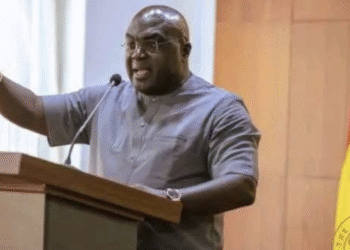
Ofoase-Ayirebi Member of Parliament and former Information Minister, Kojo Oppong Nkrumah, has challenged the Deputy Attorney-General, Dr Justice Srem-Sai, to rely on the official court record after the latter accused his legal team of basing its challenge to criminal trials during the judicial vacation on a “deliberate falsehood.”
Mr Oppong Nkrumah said the characterisation was misleading and did not accurately reflect what transpired before the Supreme Court during the hearing of his application.
His response follows the dismissal of his application for an interlocutory injunction seeking to halt selected criminal trials being conducted during the legal vacation.
Justice Gabriel Pwamang, sitting as a single justice of the Supreme Court, dismissed the application on Friday, August 21, 2026, allowing the affected proceedings to continue while the substantive constitutional case remains pending.
But Mr Oppong Nkrumah insists that the ruling should not be interpreted as a determination that his constitutional challenge was based on false information.
He said his legal team has requested a certified copy of the ruling and will examine the judge’s reasoning before deciding on the next legal step.
“Where did the Judge find that it was based on ‘deliberate falsehoods’?” he asked, arguing that the proceedings were witnessed by journalists and that the court record remains available to establish what was actually argued.
Dispute over what the court heard
At the centre of the disagreement is the interpretation of the Chief Justice’s decision to permit certain High Court judges to conduct criminal proceedings during the legal vacation, which runs from August 1 to September 30.
Mr Oppong Nkrumah’s substantive case challenges the constitutional basis of the arrangement, including whether the administrative decision could result in unequal treatment or selective justice by allowing some criminal matters to proceed while others remain outside the vacation sittings.
Dr Srem-Sai, however, disputed the factual foundation of the MP’s application during the injunction proceedings.
The Deputy Attorney-General argued that the applicant had portrayed the Chief Justice’s warrant as assigning selected cases to two judges for hearing during the vacation.
According to the State’s position, the evidence before the court did not support that interpretation.
Dr Srem-Sai reportedly pointed to exhibits filed by Mr Oppong Nkrumah, including the warrant issued by the Chief Justice, which he argued was general rather than limited to particular cases.
He also cited another exhibit which, according to him, indicated that 29 judges were sitting during the vacation, rather than the two judges alleged in the application.
It was against this background that the Deputy Attorney-General criticised the constitutional challenge and linked it to a one-week disruption in court activities.
‘Constitutional right cannot become a falsehood’
Mr Oppong Nkrumah has rejected that argument, insisting that the unsuccessful outcome of an application does not automatically make the underlying constitutional challenge false or deceptive.
He argued that citizens have a constitutional right to seek judicial interpretation where they genuinely believe that constitutional provisions, rights or procedures have been breached.
“If my application has resulted in the courts not sitting for one week, that does not transform the constitutional right to seek interpretation into a falsehood,” he said.
The MP also questioned the Deputy Attorney-General’s criticism of the litigation, arguing that government lawyers should be among those defending respect for judicial processes.
“The Deputy Attorney General cannot insist that courts must be respected and then attack litigants for invoking the powers of these very courts,” he said.
Substantive case still pending
The dismissal of the interlocutory injunction does not dispose of the substantive constitutional action filed by Mr Oppong Nkrumah.
The main case remains focused on the constitutional validity of the Chief Justice’s administrative arrangements for criminal proceedings during the legal vacation and whether the exercise of that authority raises questions concerning equality before the law, selective justice and the administration of justice.
Mr Oppong Nkrumah maintains that his objective is to obtain a judicial determination on those constitutional questions rather than to obstruct the work of the courts.
The State, on the other hand, maintains that the Chief Justice’s administrative arrangements do not unlawfully interfere with the independent judicial functions of High Court judges.
With the injunction application now dismissed, attention is expected to shift to the substantive constitutional case, where the Supreme Court will ultimately determine whether the arrangements challenged by the MP are consistent with the Constitution.
For Mr Oppong Nkrumah, however, the immediate dispute over whether his case was founded on a “deliberate falsehood” is one he believes can be resolved by the court’s own record.
He said his legal team would first study Justice Pwamang’s certified ruling before determining how to proceed with the substantive constitutional challenge.