
















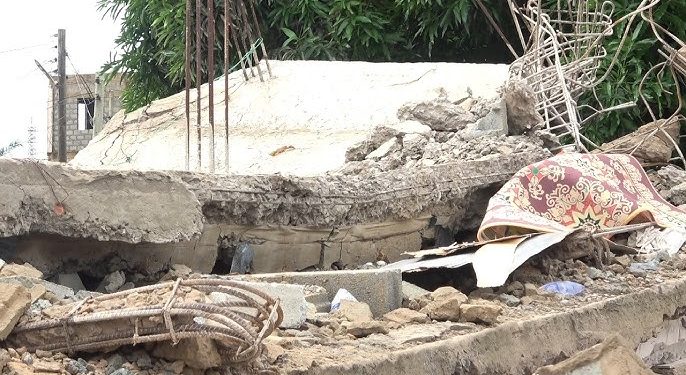
The collapse of a three-storey building at Adenta New Site has uncovered serious violations of Ghana’s building regulations, with preliminary investigations revealing that the developers proceeded with construction without the required approvals and ignored official stop-work orders.
A Joint Technical Investigative Committee, comprising structural engineering experts and representatives of the Ghana Institution of Engineering (GhIE), the Institution of Engineering and Technology, Ghana (IET-Gh), and the Architecture Registration Council (ARC), disclosed the findings in a statement issued on Monday, June 8, 2026.
According to the committee, the project lacked critical statutory approvals, including approved architectural and structural drawings, building permits, and other mandatory technical documentation. Despite interventions by the Municipal Assembly, construction reportedly continued in defiance of official directives to halt work.
The building collapsed on June 3, trapping five occupants beneath the debris. Four victims — Fred Atagba, Solomon, Seyeram Dzigda, and David Dzigda — were rescued alive and taken to the 37 Military Hospital for treatment, while Margaret Kpeli lost her life in the incident.
Investigators found that an additional floor was being constructed on the building at the time of the collapse. The committee said the unauthorised vertical expansion placed excessive stress on a structure that had not been designed to support the extra load.
The investigation also revealed that parts of the building remained occupied while construction activities were ongoing, heightening the risk to residents.
Preliminary assessments identified multiple structural deficiencies, including discontinuous load-bearing columns, poor-quality concrete, inadequate support systems, and improperly detailed reinforcement. These defects are believed to have played a significant role in the failure of the structure.
The committee noted that the nature of the collapse was consistent with a progressive or “pancake” failure, where the collapse of key structural components triggers the sequential failure of floors above or below.
To support further investigations, samples of concrete and steel reinforcement have been collected for laboratory testing to determine whether they met approved engineering standards.
The committee has recommended that the National Disaster Management Organisation (NADMO) secure the site and supervise the safe demolition of unstable portions of the structure to prevent further harm.
The incident has renewed concerns about compliance with building regulations and the effectiveness of enforcement mechanisms, with investigators warning that strict adherence to approved construction standards and professional supervision remains essential to preventing similar tragedies.






