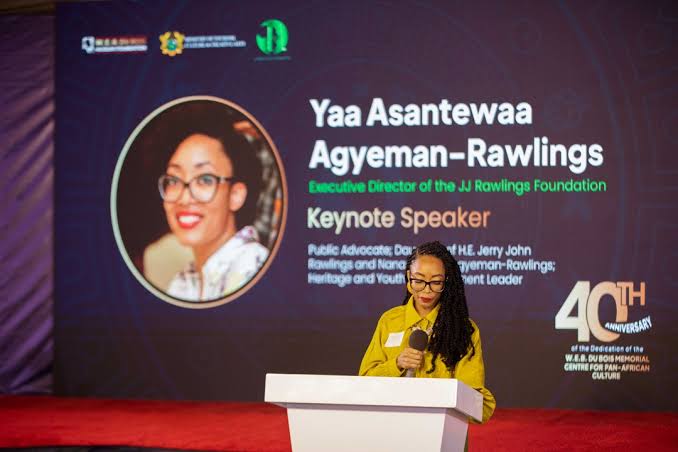
Nana Konadu Agyeman-Rawlings used Ghana’s decentralisation programme in the 1980s as an avenue to encourage more women to participate in local governance and public service, her daughter, Ms Yaa Asantewaa Agyeman-Rawlings, has said.
She said her mother recognised that the establishment of district-level structures offered women an opportunity to take part in decision-making and contribute directly to the development of their communities.
According to Ms Agyeman-Rawlings, Nana Konadu, through the 31st December Women’s Movement, went into communities to educate residents on the importance of decentralisation when the Provisional National Defence Council (PNDC) introduced the programme in the mid-1980s.
“She also recognised the opportunity presented by district-level elections and encouraged many women including some of her own organisers to put themselves forward for election and public service,” she said.
Ms Agyeman-Rawlings, Executive Director of the J.J. Rawlings Foundation, said her mother’s approach to community development was rooted in direct engagement with the people rather than working from a distance.
“She did not believe in championing an idea from a distance. She went where the people were. She listened, mobilised, organised, and acted,” she stated.
She was speaking at the launch of the Sheroes of Africa Coffee Table Book, authored by Princess Flossy Tachie-Menson to celebrate 100 remarkable African women whose lives, leadership and courage have contributed to shaping the continent.
Ms Agyeman-Rawlings said Nana Konadu’s community-based work went beyond women’s empowerment to include efforts aimed at political, social and economic transformation.
She explained that her mother believed sustainable national development required communities to be empowered and people equipped with the confidence and capacity to influence their own future.
That approach, she said, created a multiplier effect, with community-level empowerment contributing to broader national development.
Ms Agyeman-Rawlings said Nana Konadu’s work had consequently left an impact on women who gained confidence, communities whose aspirations were broadened and young people who found an example of courage and resilience in her.
“Her legacy, therefore, belongs not only to her children or to her family. It belongs to the women whose confidence she awakened; to the communities whose horizons she expanded; to the young people who saw in her an example of courage and resilience,” she said.
She commended the Sheroes of Africa publication for documenting the contributions of African women and preserving their stories and legacies for future generations.
Ms Agyeman-Rawlings said the inclusion of Nana Konadu in the publication was particularly significant to the family, adding that her mother’s contribution should be viewed as an inspiration to others to continue serving their communities.
She also reminded the audience that October 23, 2026, would mark one year since Nana Konadu Agyeman-Rawlings died.
She said her mother’s physical departure did not bring an end to the impact of her life, because her influence continued through the people she inspired, communities she strengthened and the values she promoted.
The launch was chaired by former Malawi President, Dr Joyce Banda, who is also Chairperson of the Sheroes Foundation.