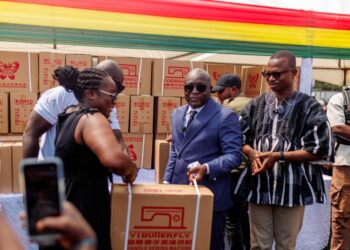
In an exclusive interview, Chief Musah Yahaya Yandu III reflects on the lessons of Ramadan, thanks President Mahama for the two-day holiday, and appeals for global harmony.
As the sun rose over the capital marking the end of the holy month of Ramadan, the air was thick with the spirit of Alhamdulillah—gratitude to the Almighty. But for Chief Musah Yahaya Yandu III, Chief of Zabarma and President of the National Council of Zabarma Chiefs, Ghana, this Eid Mubarak carries a message that transcends the usual festivities.
In a heartfelt exclusive interview with NewsGhanaonline, the respected traditional leader did not just offer greetings; he delivered a masterclass in the virtues of patience, tolerance, and the indispensable value of peace.
The Primacy of Peace
Seated in a calm demeanor befitting the day, Chief Yandu began by anchoring the celebration in its most fundamental element: peace.
“In the first place we say Eid Mubarak, we say, Eid Mubarak, we say, Eid Mubarak, again, you know, it’s only peace,” he stated. “As a Muslim we see peace, that is what will bring Salaam Alaikum. If you have peace, you come to the door, you say Salaam Alaikum, and then wait for somebody to even open for you. But if there is no peace and you come, you don’t need to even say Salaam Alaikum. We just open and enter.”
He offered profound thanks for the tranquility enjoyed in Ghana. “Allah has given us peace in Ghana. So we pray
peace to prevail in other countries too. Because without peace, there is no development.”
The Lesson of Respect
As the interview progressed, Chief Yandu highlighted a significant point of unity that emerged from the recent Ramadan observance. While there were initial discrepancies regarding the start of the fast—some starting on Wednesday, others on Thursday—the leader urged the community to focus on the higher lesson.
“Respect, respect is something we should all embrace,” he said, his tone firm yet fatherly. “We started this fasting. Some said Wednesday, some said Thursday, but patiently at the day
end of it, those who had Wednesday had 30 days. And then those who had Thursday have 29 days.”
He explained that such differences are expected in Islam, where the lunar month is either 29 or 30 days. However, what could have been a source of division was instead a moment for reflection.
“What I’m saying is that the peace that I’m talking about… in some country, can raise tension, and then there will be a fight that you and I cannot stand it. So we say Alhamdulillah for Ghana,” he emphasized.
Chief Yandu implored the youth to embrace respect—respect for elders and for each other. “When you respect, you
go far. We want them to respect each other, respect the elders and also the elders, you should have sympathy of the young ones.”
He urged the younger generation to adhere to tradition, noting, “If your father is alive, and then this thing came, he couldn’t fight, and then see why you should also fight over it.”
Gratitude to the President
The Chief reserved special praise for the President of the Republic, His Excellency John Dramani Mahama, for a policy change he believes will permanently eliminate the logistical tensions that sometimes accompany the Eid crescent sighting.
“The President of the Republic, His Excellency President John Dramani Mahama… what the President has done, going forward, you will see that there will be no problem,” Chief Yandu declared. “You end your fasting today, you want to pray today. Pray. I end my fast; I want to pray the next day. I pray.”
He was referring to the declaration of two public holidays for the Eid-ul-Fitr celebration, a move he says fosters unity. “On behalf of the National Council of Zongo chiefs, we are thanking him. And we know as human beings and just like Oliver Twist, we always ask for more.”
Reflecting on history, he noted the progress: “Our great grandfathers did not get one day as a holiday. They will
go to work on Sallah day… today, God has done it for us. When it is Sallah, each and every Ghanaian knows there is Sallah, because you can’t go to work.”
A Plea for the World
Beyond Ghana’s borders, the Chief’s concern was palpable. Looking at the ongoing crises in the Middle East, he lamented the impact on developing nations, describing them as the “most vulnerable.”
“Things were changing all over the world,” he recalled. “I want to go to Omra. I pay for tickets to Dubai, Jeddah, and Medina, and it cost GHs 9,000.00 plus, not even GHs10,000.00. Some time back you pay like GHs 40,000.00. So you see, things were getting better, until this
thing again.”
He made a direct appeal to the international community. “We are begging President Donald Trump. We are begging him. He should withdraw, and let peace prevail so that we all have peace.”
The Ghanaian Example
Despite the global turmoil, Chief Yandu pointed to Ghana as a beacon of interfaith harmony, a model he believes the world can learn from.
“Ghana, Allah has blessed us, Muslims and Christians live together in harmony,” he noted. Recalling a recent Iftar at the Flagstaff House, he said, “We have a reverend father from the Catholic
church… not only Muslims were present, we have Christians there to breakfast. Unlike those days, they would have said ‘this is for the Muslims.’ But this one, we came together.”
He recounted how the National Chief Imam visits the Reverend Father to say hello, and how a pastor once gifted the Chief Imam a car. “You can’t get it anywhere,” he marveled.
Final Message
As the interview concluded, Chief Yandu offered a final prayer for the nation and a word of caution to the youth against reckless behavior during the celebrations.
“I will not be happy seeing my son on a
day like this, riding recklessly on a motorbike. I will not be happy. I know each and every father will not be happy.”
He extended his warmest wishes to the Muslim Ummah and all Ghanaians. “Today everybody knows that is it Sallah. So we pray that the EID should affect each and every one of us… I pray that the Eid should circulate for everybody.”
With a final, resonant “Eid Mubarak,” the Chief of Zabarma offered a message that was less about the end of a fast and more about the enduring strength of a nation built on respect and peace.
By Kingsley Asiedu