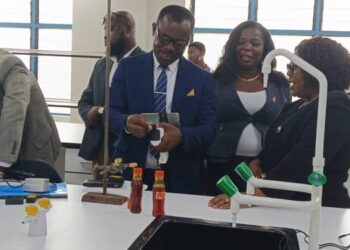
Adisadel College in Cape Coast is positioning its students for careers in emerging technologies with the launch of three specialised STEM clubs designed to move learning beyond the classroom into practical innovation.
The initiative, comprising the Math Club, Engineering Club and Aviation and Drone Club, is expected to give students hands-on experience in areas including robotics, artificial intelligence, drone technology, microelectronics, mathematical modelling and mechanical fabrication.
The clubs were initiated by old students of the College, who have already established and fully equipped three specialised laboratories to support practical training and research. Additional laboratories are also being developed.
The initiative seeks to establish the school as an incubator for research, creativity and technological innovation while exposing students to career opportunities in high-growth sectors.
An old student and aviation enthusiast, George Arthur, said the initiative was designed to prepare young people for the demands of the Fourth Industrial Revolution.
He said the traditional approach of relying heavily on rote learning must give way to experiential, interdisciplinary and problem-based education.
According to him, the three clubs are intended to bridge the gap between theoretical knowledge acquired in classrooms and practical solutions to challenges confronting society.
“By training simultaneously across mathematics, physical engineering, and flight technology, you are acquiring the cross-disciplinary versatility that defines modern leaders,” he said.
Mr Arthur said STEM education could play a critical role in transforming sectors such as agriculture, healthcare, logistics, mining and environmental management.
He argued that Ghana could develop many of the technological solutions it currently imports by investing in the technical capabilities of young people.
The Math Club will focus on advanced problem-solving, financial modelling and computational thinking, while the Engineering Club will provide opportunities for students to apply mathematical concepts through robotics, rapid prototyping, microelectronics and mechanical fabrication.
The Aviation and Drone Club, meanwhile, will expose students to drone construction and operation, with members expected to collaborate with the other clubs to develop solutions for areas such as agriculture and healthcare.
Mr Mark Kwegyir Aggrey, an old student and IT expert, urged students to take advantage of the initiative by developing solutions to practical problems within their schools and communities.
He said members would work on real-world projects and could earn certifications based on their participation and achievements.
Mr Aggrey stressed that membership would not be restricted to students studying science-related programmes, but would be open to anyone with an interest in innovation, technology and problem-solving.
He also encouraged students to use AI tools, search engines and other learning resources to research, experiment and develop their ideas.
However, he cautioned that membership would come with a responsibility to demonstrate commitment and discipline.
Students who fail to take the activities seriously, he warned, could be removed from the clubs.
Patron of the Aviation and Drone Club, Prince Boateng, said the club would adopt a two-tier training structure, including professional-level instruction and certification for students who meet the required academic and behavioural standards.
He said the club would draw on expertise from professionals at the Ghana Civil Aviation Authority, international specialists and old students to provide training and mentorship.
The initiative is expected to give Adisadel students early exposure to technical fields while helping nurture a new generation of engineers, pilots, software developers, data scientists, technology entrepreneurs and inventors.