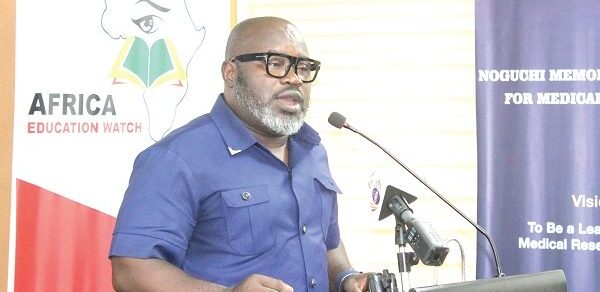
Africa Education Watch (Eduwatch) has challenged the government’s approach to examination malpractice, arguing that the rising prevalence of the practice shows that arrests and sanctions alone are failing to address the problem.
Executive Director of Eduwatch, Kofi Asare, said available statistics point to a significant increase in examination malpractice over the years, despite efforts by authorities to arrest and punish offenders.
Speaking on Joy FM’s Super Morning Show on Tuesday, September 15, Mr Asare said the proportion of examination malpractice rose from about 0.9 per cent in 2018 to 13.5 per cent in 2024, before increasing further to 14.8 per cent in 2025.
He said the figures contradicted claims that the problem was declining and urged education authorities to focus on the underlying behavioural factors driving candidates and others to engage in examination fraud.
“I disagree with the President’s assertion that examination malpractice is declining,” Mr Asare said.
He explained that Eduwatch assessed progress based on the prevalence of malpractice rather than the number of arrests, since there was no comprehensive data available to establish whether arrests had increased or decreased.
“We measure progress by the number of people participating in the fraud, not the number of people being arrested, because we don’t have data for that,” he said.
Mr Asare said the situation was particularly worrying because the increase continued between 2024 and 2025.
“Between 2024 and 2025, it did not decline. It will increase further from 13.5 percent to 14.8 percent. We are waiting for 2026 data,” he said.
He also cited figures from the Basic Education Certificate Examination (BECE), which he said showed a sharp increase in malpractice-related cancellations between 2024 and 2025.
According to him, malpractice involving subject cancellations and cancellation of entire results increased from 4.22 per cent in 2024 to 28.95 per cent in 2025.
He said although the country recorded a decline in malpractice in 2020, the overall trend remained concerning and required interventions beyond enforcement.
“For us at Eduwatch, we see this as a behavioural challenge for which the solutions should be change in attitude and behaviour,” Mr Asare said.
He further disclosed that more than 7,000 candidates had their results cancelled on the basis of subject-related examination malpractice, highlighting the impact of the practice on students.
Mr Asare said the figures should prompt stakeholders in the education sector to examine why candidates, teachers and other actors continue to participate in examination fraud and develop interventions capable of changing such behaviour.
He maintained that the 2026 examination data would provide an important indication of whether the trend had begun to reverse.
Until those figures are available, however, he said the statistics from 2024 and 2025 did not support the assertion that examination malpractice was declining.