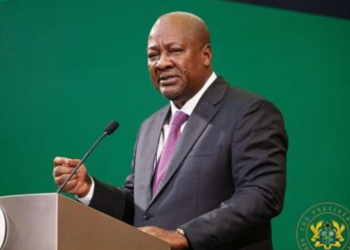
Former Vice President of Ghana, Dr. Mahamudu Bawumia, has called on global policymakers to focus on addressing the deeper macroeconomic factors driving trade imbalances, rather than relying solely on tariffs as a solution.
Speaking at the International Democracy Union (IDU) Forum in Brussels, Dr. Bawumia highlighted that trade deficits are largely the result of broader economic dynamics, such as national savings and investment levels, rather than mere trade policy issues.
He pointed to the stark contrast in global trade figures, noting that Africa accounts for just 2.5% of global exports and 2.9% of imports, compared to Asia’s 43% and 38%, Europe’s 38% and 51%, and the United States’ 8% and 14% respectively.
“These figures reflect structural economic realities, not just policy choices,” Dr. Bawumia argued, stressing that efforts to correct trade imbalances must address the underlying economic conditions that drive these disparities.
He explained that trade deficits arise when a country spends more than it saves, creating a gap that cannot be resolved through tariffs alone.
“Trying to correct a trade deficit with tariffs is like treating the symptoms of a disease without addressing the root cause,” he said. “The deficit is a macroeconomic problem. It’s about the relationship between national savings and investment, not just trade policy.”
Dr. Bawumia urged policymakers to take a broader view of economic management, emphasizing that sustainable trade balances require sound fiscal policies and long-term structural reforms.