
















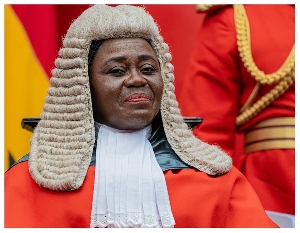
Tensions are rising across Ghana as legal experts, political leaders, and civil society voices caution against what they describe as a dangerous precedent following the suspension of Chief Justice Gertrude Araba Sackey Torkornoo by President John Dramani Mahama.
During a televised discussion in Accra on Saturday, April 26, 2025, former Deputy Attorney-General and Minister of Justice, Madam Diana Asonaba Dapaah, firmly argued that there was no justification for establishing a prima facie case against the Chief Justice. She criticized the petitions submitted — including those from the Xavier Group — as lacking substantial evidence and warned that moving forward with such weak allegations could threaten judicial independence and Ghana’s constitutional democracy.
Madam Dapaah emphasized that while Article 146 of the 1992 Constitution provides a procedure for addressing alleged misconduct by justices, the threshold for establishing wrongdoing must not be lowered for political convenience. “The petitions are largely based on misinterpretations and unproven assertions,” she said. “We must be careful not to erode the sanctity of our judiciary.”
Her remarks came after President Mahama, acting in consultation with the Council of State, suspended the Chief Justice on April 22, citing a prima facie case established from three separate petitions. A five-member committee has been constituted to investigate the allegations.
However, several prominent figures have called for greater caution. Former Parliamentary Constitutional, Legal, and Parliamentary Affairs Committee Ranking Member, Mr. Inusah Fuseini, stressed that while the constitutional process under Article 146 must be respected, the judiciary’s independence must remain protected. “We must trust the constitutional process, but we must also guard against abuse,” he stated.
Former UN Senior Governance Advisor, Professor Baffour Agyeman-Duah, echoed concerns about the separation of powers, urging political actors to avoid setting dangerous precedents that could weaken democratic institutions. “Citizens have the right to petition,” he noted, “but removing a top judicial officer must be approached with extreme care.”
Meanwhile, Oliver Barker-Vormawor, Constitutional Rights and Policy Strategy Advisor at Democracy Hub, cautioned that while petitions raising judicial incompetence should not be dismissed outright, the integrity and fairness of the process must be beyond reproach. “This is not a moment for politics,” he warned. “It is a moment for protecting the Constitution.”
In a sharp political response, the New Patriotic Party (NPP) and four other parties — the Liberal Party of Ghana, National Democratic Party, People’s National Party, and Ghana Union Movement — have announced plans to hold a nationwide demonstration on Monday, May 5, 2025. They argue that the suspension of the Chief Justice is an “absurd and unconstitutional” attack on the Judiciary and are rallying in defense of the country’s constitutional order and judicial independence.
As the nation braces for protests and further political tension, calls for calm, respect for due process, and the protection of Ghana’s democratic values are growing louder.






