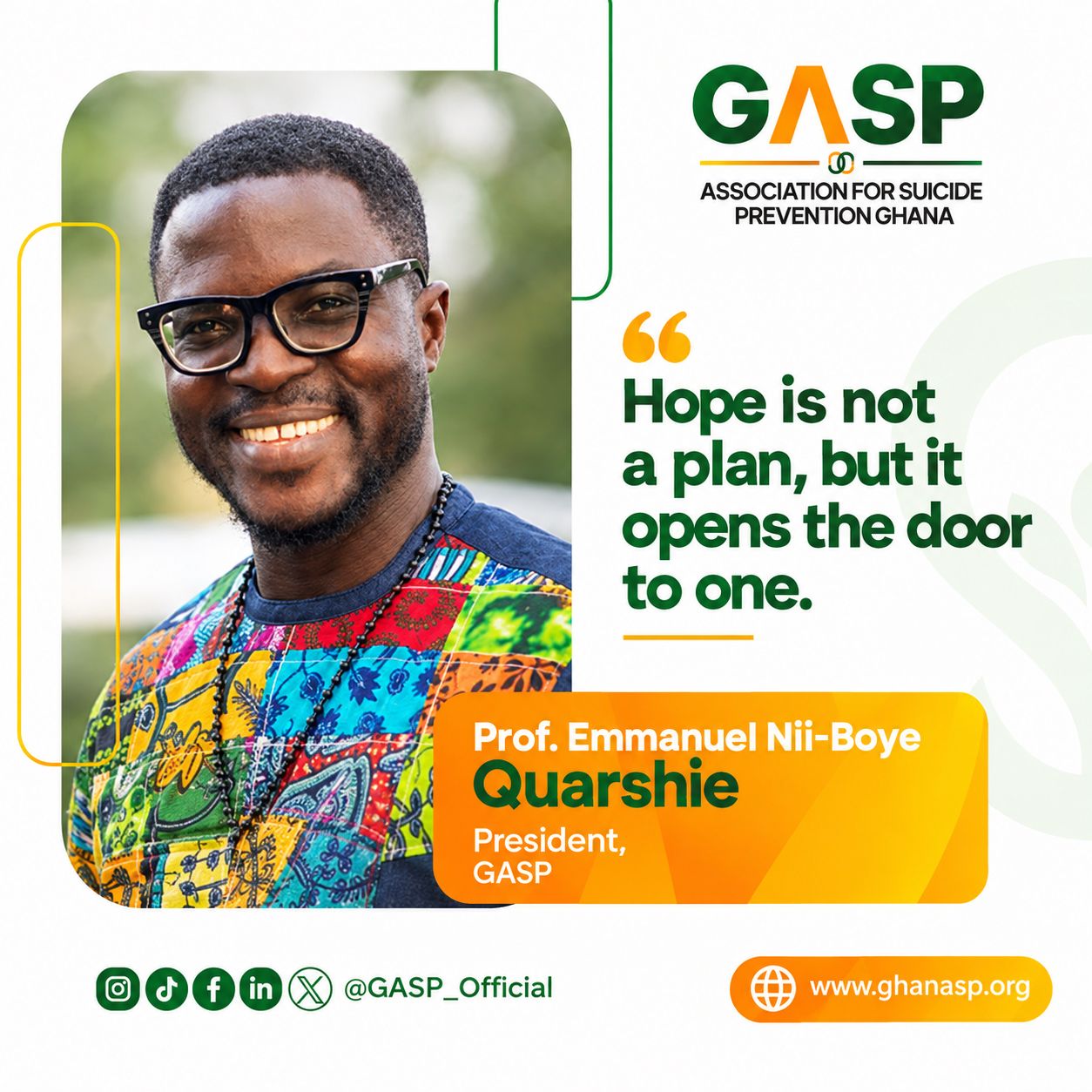
The Association for Suicide Prevention Ghana (GASP) has called for suicide prevention to become part of everyday conversations in homes, schools, workplaces, health facilities, churches and other social spaces, including online communities.
The Association said creating an environment where people could openly discuss emotional distress without fear of judgement was essential to preventing suicide and connecting vulnerable individuals to appropriate care.
In a statement to mark World Suicide Prevention Day 2026, GASP said Ghana recorded 134 suicide deaths in 2024, alongside more than 1,100 reported suicide attempts.
It said preliminary reports for 2025 indicated that 175 suicide deaths were recorded within the first six months of the year.
GASP, however, noted that the figures represented reported cases and could partly reflect improved reporting following the decriminalisation of attempted suicide in Ghana.
The Association said a study involving 1,101 school-going adolescents aged between 10 and 19 years also found that 25.1 per cent had experienced suicidal thoughts within the previous 12 months.
It said the findings reinforced the need for stronger prevention measures, accessible mental health services and communities capable of responding appropriately when people show signs of emotional distress.
The statement, signed by GASP President, Professor Emmanuel Nii-Boye Quarshie, and Head of Communications and Campaigns, Ms Akosua Donkor, said the final year of the 2024–2026 World Suicide Prevention Day theme, “Changing the Narrative on Suicide,” provided an opportunity to sustain the conversations generated over the past three years.
According to the Association, changing the narrative requires moving away from silence, stigma and misunderstanding towards openness, empathy and support.
It said people experiencing suicidal thoughts should not be viewed as weak or morally deficient, but as individuals who could be experiencing overwhelming psychological pain and requiring understanding, support and appropriate care.
GASP cautioned against dismissive responses when people disclose that they are struggling.
It said comments such as “just pray harder,” “think positively” or “forget about it” could unintentionally deepen feelings of isolation.
The Association acknowledged that faith, spirituality and encouragement could be important sources of support for many people but stressed that they should not substitute professional mental health care when additional assistance was required.
It said suicide prevention should begin with compassion, active listening and recognition that mental health was an integral part of overall health.
GASP also highlighted the role of the media in shaping public understanding of suicide and called for responsible reporting that could contribute to prevention rather than stigma.
It said it had collaborated with stakeholders in the media and mental health sectors, including the Mental Health Authority and the World Health Organisation (WHO), to develop the “Ghana Guidelines for Appropriate Media Reporting of Suicide.”
The guidelines, it said, were to be launched by the Mental Health Authority.
GASP urged individuals, communities, organisations and government institutions to sustain conversations on suicide prevention beyond the 2026 theme.
It encouraged the public to ask questions, listen without judgement, offer support and help people experiencing emotional distress connect with appropriate care.
The Association said suicide affected not only individuals but also families, friends, colleagues and communities, leaving lasting emotional, social and economic consequences.
It therefore called for a society in which people experiencing suicidal thoughts or emotional distress could seek help without fear of stigma or rejection.
People experiencing emotional distress or needing mental health support can contact the Mental Health Authority’s toll-free helpline on 0800678678.