
















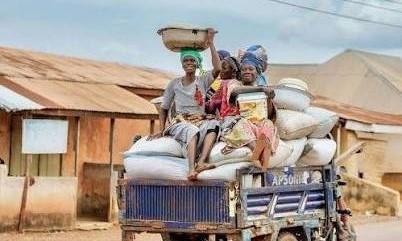
Ghana’s informal cross-border trade reached an estimated GH¢31 billion during the first nine months of 2025, with tricycles playing a central role in moving billions of cedis worth of goods across the country’s borders, according to new data from the Ghana Statistical Service (GSS).
The findings, contained in Ghana’s first comprehensive survey of informal cross-border trade, reveal the enormous contribution of small-scale traders whose activities have traditionally remained outside official trade statistics.
According to the GSS, tricycles—popularly known as aboboyaa—have become the preferred means of transporting goods through informal border routes, carrying an average of GH¢2 billion worth of exports and GH¢1.7 billion worth of imports between January and September 2025.
The survey covered 206 active border crossing points linking Ghana with Togo, Burkina Faso and Côte d’Ivoire, documenting trade conducted outside the formal customs system by thousands of small-scale traders.
Unlike formal international trade, which is dominated by large commercial transport operators, the informal sector relies heavily on individuals transporting relatively small quantities of goods frequently across nearby borders.
The report indicates that the affordability, flexibility and accessibility of tricycles have made them indispensable to traders operating in border communities, enabling them to transport farm produce, consumer goods and other merchandise efficiently between markets.
The GSS noted that the findings provide valuable insight into an economic sector that supports thousands of livelihoods but has remained largely unmeasured in official national accounts.
“Counting it is the first step to strengthening it,” the Statistical Service stated, emphasising that improved data would enable policymakers to design interventions that better support informal traders while strengthening national economic planning.
The survey further revealed that informal trade accounted for a significant proportion of Ghana’s commercial exchanges with neighbouring Togo and Côte d’Ivoire, underscoring the critical role of small-scale traders in promoting regional commerce.
Beyond its contribution to trade volumes, the informal cross-border economy remains a major source of employment and income for households in many border communities, where trading activities sustain local economies.
To strengthen the sector, the GSS recommended simplifying registration and licensing procedures for small-scale traders, improving infrastructure at major border crossings and expanding access to financial services tailored to the needs of informal traders, particularly women.
The Service also called for closer collaboration among the Ghana Statistical Service, the Ghana Revenue Authority and the Ghana Immigration Service to improve the collection of border trade data and strengthen evidence-based policymaking.
With Ghana positioning itself to maximise opportunities under the African Continental Free Trade Area (AfCFTA), the report highlights the importance of recognising and supporting informal trade, which continues to facilitate regional commerce through thousands of daily transactions that often go unrecorded.






