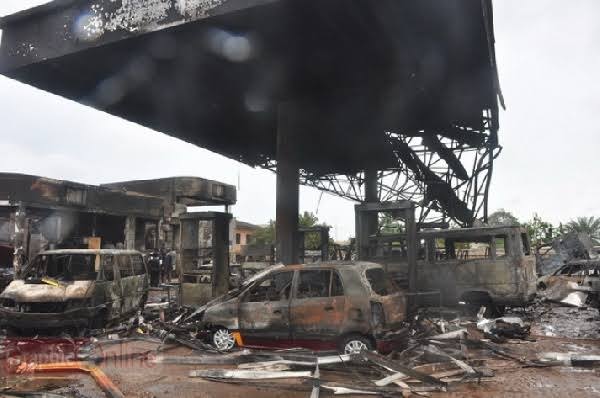
Eleven years ago, on the night of June 3, 2015, Accra witnessed one of the deadliest urban disasters in Ghana’s history.
Torrential rains triggered a twin flood and fire incident at a fuel station near Kwame Nkrumah Circle, claiming 159 lives and leaving hundreds of families devastated.
The disaster, now etched into the nation’s memory as “June 3”, exposed deep-rooted challenges in urban planning, drainage infrastructure, environmental sanitation and disaster preparedness.
More than a decade later, as another rainy season unfolds, the questions remain: Have the lessons been learnt? Has enough changed to prevent a similar catastrophe?
The Night Accra Stood Still
The rain had been falling for hours.
What began as another stormy evening in Accra gradually turned into a nightmare.
Water surged through the streets of the capital, swallowing roads, vehicles and homes. At Kwame Nkrumah Circle, frightened commuters, traders and residents scrambled for safety as floodwaters rose.
Many sought refuge at the nearby GOIL filling station, believing its canopy offered protection from the downpour.
They had no idea they were walking into the deadliest urban disaster in Ghana’s recent history.
Then came the fire.
Fuel from underground tanks reportedly mixed with floodwaters that had engulfed the area. Around 2300 hours, fire broke out and spread rapidly across the floodwaters.
Within moments, flames raced across the surface, trapping scores of people who could not escape due to submerged exits and blocked roads.
Panic erupted.
People ran in every direction.
But there was nowhere to run.
On one side was raging fire. On the other was chest-high floodwater.
The air filled with screams.
Men shouted for help.
Women and children wailed.
Passengers trapped inside vehicles pounded on windows desperately seeking a way out.
Eyewitnesses later recounted hearing people screaming from taxis and nearby vehicles as flames closed in.
Then an explosion erupted.
The screams stopped.
Silence followed.
Another explosion.
More silence.
For many trapped that night, help never came.
By dawn, the rain had eased, but the horror remained.
Burnt vehicles stood like skeletons along the roadside. Twisted metal littered the area. Bodies lay among the debris, many burnt beyond recognition.
The smell of fuel, smoke and death hung heavily in the air.
The 37 Military Hospital alone received more than 100 bodies, while other health facilities also recorded fatalities.
Ghana awoke to a tragedy that left 159 people dead and plunged the nation into mourning.
More Than Half a Century of Warnings
Perhaps the most sobering reminder that Ghana’s flooding challenge did not begin with June 3 can be found in the archives of the Media.
On April 18, 1960, the Daily newspaper carried a front-page headline: “When the Rains Came to Accra”.
The accompanying photographs showed flooded streets around Kwame Nkrumah Circle, vehicles stranded in water and residents struggling to cope.
The report noted that more than two inches of rainfall had fallen within hours, causing disruption across parts of the capital.
More than six decades later, the images look eerily familiar.
The vehicles may have changed.
The buildings may be taller.
The population may have multiplied.
But the floodwaters still find the same city.
Long before June 3, 2015, Accra had experienced major floods in 1955, 1960, 1963, 1973, 1986, 1991, 1995, 1999, 2001, 2002, 2010 and 2011. Researchers describe flooding as one of the city’s longest-running urban challenges.
The question, therefore, is not whether Accra knows its problem.
The question is why the problem remains.
How does a city spend more than six decades confronting the same threat, mourning the same losses, issuing the same warnings and making the same promises?
How many floods must occur before flooding ceases to be described as a natural disaster and is recognised as a failure of planning, enforcement and collective responsibility?
Eleven years after June 3, the GOIL filling station still stands at Circle.
Thousands pass it every day.
For some, it is simply a fuel station out of operation.
For others, it is a memorial.
A monument to 159 lives lost.
A reminder of promises made.
A reminder of warnings ignored.
And perhaps most painfully, a reminder that while the victims are gone, many of the conditions that contributed to their deaths remain.
In 1960, Accra asked how to deal with floods.
In 2015, Accra asked how to prevent another June 3.
In 2026, Accra is still asking many of the same questions.
Across the road, the line of burnt vehicles parked in a yard adjacent to Ghana Commercial Bank serves as another silent reminder of that dreadful night when ordinary people seeking shelter from the rain found themselves trapped between floodwaters and flames.
President John Dramani Mahama at that time declared three days of national mourning as the nation grieved one of the worst disasters in its history.
After visiting the scene, visibly shaken by the scale of destruction, he made a solemn pledge: “Never again”.
It was a promise born out of grief, shock and determination that such a catastrophe should never be repeated.
Yet eleven years later, as floodwaters continue to inundate parts of Accra during heavy rains and many vulnerabilities identified after the disaster remain unresolved, an uncomfortable question persists: Has Ghana truly learnt the lessons of June 3?
What the Inquiry Revealed
In the aftermath, government established a Commission of Inquiry chaired by a retired Justice of the Court of Appeal, to investigate the causes and circumstances surrounding the tragedy.
The Commission concluded that the disaster was not the result of a single event but a combination of environmental, infrastructural and human factors.
Its findings pointed to flooding as the remote cause, while the spread of fuel into floodwaters created conditions for the explosion and fire that followed.
The Commission also identified underlying factors, including: choked drains and waterways; uncontrolled development along watercourses; poor waste management practices; weak enforcement of planning regulations; inadequate disaster preparedness measures; and lapses in fuel station safety management.
The Commission made several recommendations, including extensive dredging of drains, stricter enforcement of planning laws, stronger environmental sanitation measures and improvements in emergency response systems.
Eleven Years Later: What Has Changed?
Since the disaster, successive governments have undertaken drainage projects, desilting exercises and demolition of structures obstructing waterways.
Public awareness about flooding has increased significantly.
Weather forecasting technology has improved, and institutions have strengthened coordination during emergencies.
Yet despite these efforts, flooding remains an annual challenge across Accra.
Communities such as Circle, Alajo, Odawna, Kaneshie, Weija, Adenta, Madina and Malam continue to experience flooding during periods of intense rainfall.
Each rainy season brings familiar images of submerged roads, stranded motorists and displaced residents.
For many observers, this raises concerns about whether recommendations made after June 3 have been fully implemented.
Climate Change and Increasing Rainfall Extremes
According to the Ghana Meteorological Agency, rainfall patterns in Accra are becoming increasingly variable and unpredictable.
Mr Nana Kofi Opoku, Principal Meteorologist at GMet, says while long-term rainfall trends do not necessarily indicate a dramatic increase in total rainfall, the intensity of rainfall events has become more pronounced.
He explained that climate change is contributing by increasing atmospheric temperatures and allowing the atmosphere to retain more moisture.
“When the atmosphere warms, it is able to hold more moisture, and the more moisture it holds, the higher the likelihood of extreme rainfall events occurring,” he said.
However, Mr Opoku stressed that climate change alone cannot explain Accra’s flooding problem.
Rather, he pointed to a combination of rapid urbanisation, inadequate drainage systems, encroachment on waterways and wetlands, and indiscriminate waste disposal.
“All these factors come together to make vulnerability in Accra very high,” he noted.
The Human Factor
While infrastructure deficiencies often dominate discussions about flooding, human behaviour continues to play a significant role.
Across many parts of Accra, drains remain clogged with plastic waste, household refuse and construction debris.
During heavy rains, waste carried into drainage channels obstructs water flow and worsens flooding.
Despite repeated public education campaigns, indiscriminate dumping of refuse remains common.
Similarly, encroachment on waterways and wetlands continues to limit the natural paths through which stormwater should flow.
Urban planners have long warned that when natural drainage systems are obstructed, floodwaters inevitably seek alternative routes — often through homes, businesses and roads.
June 3 demonstrated the consequences of these practices, yet many of the underlying behaviours persist.
The Role of Institutions
The responsibility for preventing future disasters does not rest on citizens alone.
A number of institutions have critical roles to play.
The Ghana Meteorological Agency continues to provide weather forecasts and warnings, issuing daily forecasts and emergency alerts when severe weather is expected.
The Agency shares information with key institutions, including the National Disaster Management Organisation, security agencies, aviation authorities and the media.
GMet is also introducing a Common Alerting Protocol system that will allow warnings to be transmitted directly to mobile devices and digital platforms.
However, officials acknowledge that many people continue to ignore weather advisories until disaster strikes.
NADMO remains responsible for disaster preparedness, public education and emergency response.
Yet growing urban populations and the increasing frequency of flooding events continue to place significant pressure on the organisation’s resources.
Metropolitan, Municipal and District Assemblies also have a vital responsibility to enforce planning regulations, maintain drains, improve sanitation and prevent development on waterways.
The recurring nature of flooding in some communities suggests that stronger enforcement may still be required.
Beyond Remembrance
For many Ghanaians, June 3 is more than a historical event.
It is a reminder of the devastating consequences that arise when extreme weather, environmental degradation, weak enforcement and risky human behaviour intersect.
The tragedy transformed lives, leaving families without parents, children, siblings and loved ones.
Some survivors continue to bear physical and emotional scars years after the disaster.
As Accra navigates another rainy season, experts say preventing future tragedies will require a collective effort involving government agencies, local authorities, businesses and citizens.
Improved drainage infrastructure, stricter planning enforcement, responsible waste disposal, better public compliance with weather warnings and sustained investment in disaster preparedness will all be necessary.
A Lesson Yet to Be Fully Learnt
Eleven years after the June 3 disaster, the floodwaters have long receded, but the lessons remain.
The anniversary serves not only as a moment of remembrance for the 159 lives lost but also as a call to action.
For as long as drains remain choked, waterways encroached upon and warnings ignored, the risk of another tragedy cannot be entirely ruled out.
The true tribute to the victims of June 3 may therefore lie not merely in remembering them, but in ensuring that the conditions that led to their deaths are never allowed to converge again.
Eric Appah Marfo