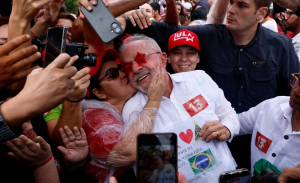
Brazilian President Luiz Inácio Lula da Silva has secured a historic fourth term in office after defeating Senator Flávio Bolsonaro by more than four million votes, in a victory that strengthens the left’s position in Latin America but sets the stage for a difficult political and economic battle.
The electoral court declared Lula the winner on Sunday, delivering a setback to the regional wave of right-wing electoral victories and defying expectations that his conservative challenger would prevail.
However, Bolsonaro, the eldest son of former Brazilian President Jair Bolsonaro, refused to concede defeat and said he would seek to have the result annulled over a Supreme Court justice’s ruling that extended voting by two hours.
The dispute raises the prospect of political tensions in the days ahead, although analysts consider an overturning of the result unlikely.
Flávio Bolsonaro had led the first round of voting but ultimately lost the runoff by more than four million votes, a margin exceeding twice the defeat suffered by his father against Lula in 2022.
Analysts also pointed to the Bolsonaro campaign’s own request for an extension of voting because of heavy rains in Brazil’s conservative-leaning south as a factor that could weaken its challenge.
Mario Braga, a Latin America analyst at risk consultancy RANE, said right-wing protests were possible but unlikely to reverse the outcome.
Lula’s Comeback Defies Political Expectations
The victory marks another remarkable comeback for the 80-year-old leader, who remains one of the most influential figures in Brazilian politics.
Lula was jailed between 2018 and 2019 over corruption charges that were later overturned, allowing him to return to electoral politics and defeat Jair Bolsonaro in the 2022 presidential election.
His latest victory makes him the first candidate since Brazil’s return to democracy in the 1980s to win the presidency after finishing second in the first round.
During the campaign, Lula defended his administration’s record on poverty reduction, inequality and social welfare, while promising further measures to ease the financial pressures facing households.
His campaign gained momentum through proposals including free nationwide public transport on weekends, which would require formal submission to Congress, and a 15 per cent increase in his flagship welfare programme, which was already being implemented.
Lula also highlighted improvements in employment, literacy and environmental protection during his third term, presenting his administration as a defender of social progress and national sovereignty.
Financial Markets React to Election Outcome
Lula’s victory unsettled financial markets that had positioned themselves for a change of government.
A Tokyo-listed exchange-traded fund tracking Brazil’s Bovespa stock index fell nearly 15 per cent in Asian trading following news of the result, while the Brazilian real was expected to weaken sharply against the US dollar.
The market reaction reflects investor concerns about the direction of economic policy under another Lula administration, particularly his commitment to state-led growth amid mounting fiscal pressures.
Brazil’s government forecasts economic growth of 2.3 per cent next year, while public debt has risen above 82 per cent of gross domestic product, its highest level since the pandemic.
High interest rates and growing household debt also remain concerns for policymakers.
Goldman Sachs expects only modest progress in controlling government spending during Lula’s fourth term, given his continued support for a state-led economic model.
Conservative Congress Could Complicate Lula’s Agenda
Despite securing another presidential mandate, Lula faces a significant obstacle in Congress, where conservative forces have strengthened their position.
Bolsonaro’s Liberal Party and its allies could control more than 280 seats in the lower house and as many as 50 seats in the Senate, giving the opposition substantial influence over legislation, budget decisions and government appointments.
The composition of Congress could force Lula to negotiate with political opponents to advance his economic and social agenda.
Analysts expect the conservative legislature to push for structural reforms favourable to businesses, potentially including spending reductions that could provoke public resistance.
Lula will also have to address concerns about household indebtedness. During the campaign, he announced a new debt-relief programme and introduced a provisional ban on online betting as part of efforts to tackle the problem.
Victory Reshapes Latin America’s Political Landscape
Lula’s re-election also carries implications beyond Brazil, Latin America’s largest economy.
His victory denies US President Donald Trump another potential right-wing ally in the region, where several conservative governments have embraced Washington’s positions on security and migration.
Lula’s supporters view his leadership as a counterweight to the growing influence of the political right across Latin America.
Celso Amorim, a former foreign minister under Lula, said the Brazilian leader would play an important role in maintaining political balance in the region.
International reactions to the result included congratulations from Canadian Prime Minister Mark Carney and several Latin American leaders.
While the election secures Lula another term, the combination of a stronger conservative opposition, fiscal constraints and investor concerns means his next administration could face some of its toughest tests yet.
The central challenge will be translating his electoral victory into economic progress while navigating a Congress that may resist key elements of his policy agenda.