The Narcotics Control Commission (NACOC) has expanded its operational footprint from fewer than 10 district commands to 77 across all 16 regions, a move the Majority in Parliament says has contributed to a sharp increase in drug-related arrests and seizures.
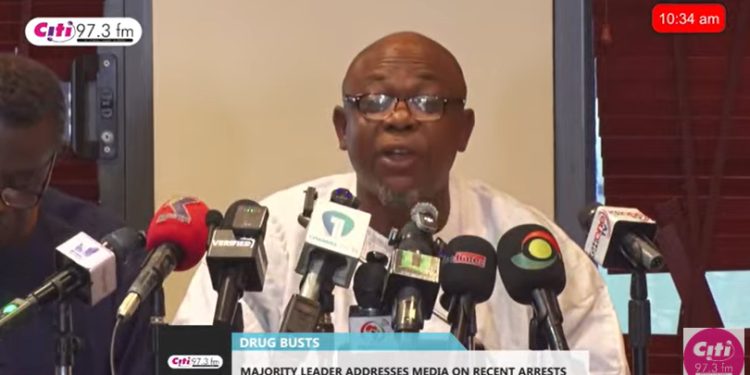
Majority Leader and Builsa North MP, James Agalga, said the expansion had strengthened NACOC’s ability to conduct intelligence-led operations and work more closely with other security agencies.
Speaking to the press on Thursday, September 24, Mr Agalga said NACOC’s enforcement figures rose significantly in 2025, with 217 arrests recorded in 165 cases, compared with 73 arrests in 2024.
He said the increase represented a 197 per cent rise in arrests and reflected what he described as stronger enforcement measures, improved inter-agency cooperation and greater operational coverage.
According to Mr Agalga, NACOC seized 1,497.75 kilogrammes of narcotic substances in 2025, with an estimated street value of US$5.24 million.
The Commission also seized 61,974 units of controlled substances, including pharmaceutical opiates and new psychoactive substances, he said.
Beyond drugs, Mr Agalga said NACOC’s asset-based enforcement activities led to the seizure of GH¢6.93 million and US$440,382 in cash, as well as 19.72 kilogrammes of gold allegedly connected to suspected drug-money laundering.
He attributed the enforcement gains to the increased presence of NACOC at the district level and closer collaboration with other security institutions.
He said the Commission had worked with the Ghana Police Service, National Intelligence Bureau, Ghana Immigration Service and Economic and Organised Crime Office to strengthen intelligence gathering and coordinated operations.
Dedicated court for narcotics cases
Mr Agalga also highlighted the establishment of a dedicated narcotics court as another measure intended to strengthen the prosecution of drug-related offences.
He said the move was aimed at addressing fragmentation in the prosecution of narcotics cases and narrowing the gap between arrests and successful convictions.
The Majority Leader said the government’s institutional interventions had created the conditions for stronger enforcement and improved the country’s response to narcotics-related crimes.
“The 2025 performance was due to the concrete institutional changes this government has put in place,” he said.
The figures cited by Mr Agalga place the expansion of NACOC’s district-level presence and the creation of specialised judicial capacity at the centre of the government’s stated strategy to strengthen Ghana’s fight against narcotics trafficking and related financial crimes.