Freshly released evidence has raised new questions about how US investigators handled material linked to Omar al-Bayoumi, a Saudi national who became an early suspect in the investigation into the September 11, 2001 attacks.
The revelations form part of a $1 trillion (£733bn) lawsuit brought by families of 9/11 victims against Saudi Arabia, who allege that the Saudi government was complicit in the attacks and that Bayoumi provided assistance to two of the hijackers.
BBC investigations have found that evidence recovered from Bayoumi shortly after the attacks was not consistently shared among investigators, despite its potential significance to the case.
Bayoumi was arrested by Britain’s Metropolitan Police in Birmingham on September 21, 2001, following the FBI’s interest in his activities and links to two of the hijackers, Nawaf al-Hazmi and Khalid al-Mihdhar.
British officers searching his properties recovered thousands of documents, hundreds of photographs and at least 80 videotapes, alongside travel records and other material.
Among the items was a handwritten diagram of an aeroplane accompanied by mathematical calculations relating to its height and distance from the ground.
The evidence was classified as high priority and was transferred to an FBI agent stationed at Paddington Green Police Station in London, where Bayoumi was being questioned.
However, British detectives investigating Bayoumi were not given the plane diagram or briefed to question him about it, according to the BBC’s investigation.
The material was also not shared with some FBI agents in San Diego, where Bayoumi had lived, despite repeated requests from investigators seeking access to the evidence seized in Britain.
Rick Lambert, who led the FBI investigation in San Diego, told the BBC that his office repeatedly requested copies of the evidence but was informed that the New York office, which had overall control of the investigation, would provide it after completing its analysis.
He said the failure to receive the material could have delayed investigators’ ability to connect important pieces of evidence.
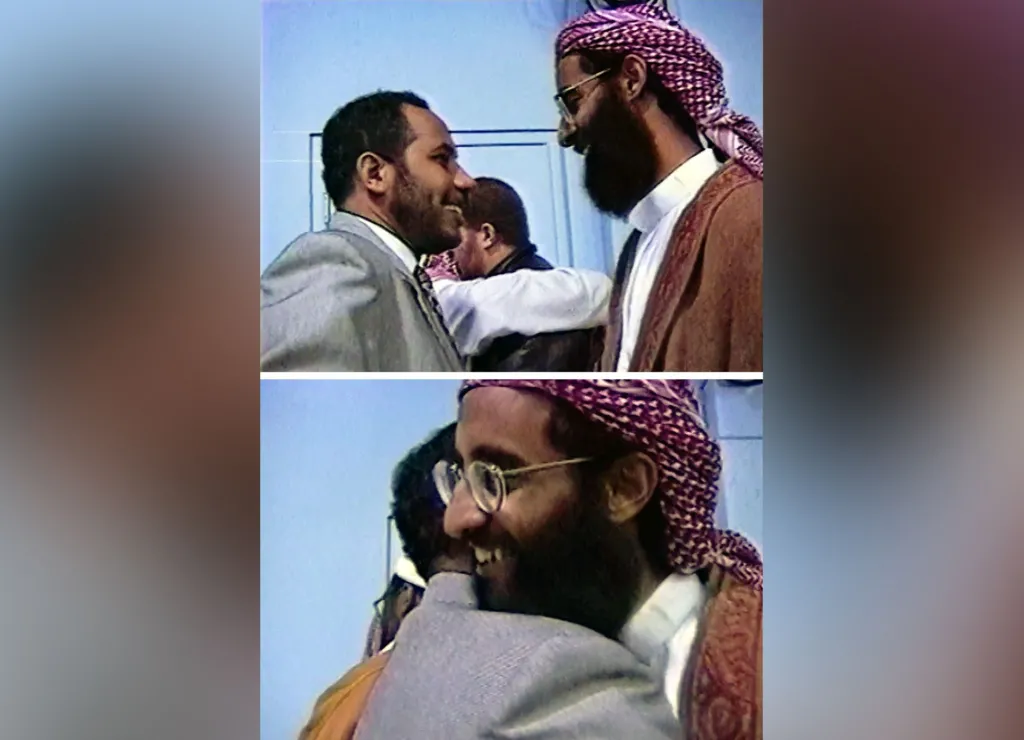
The handling of Bayoumi’s video recordings has also come under scrutiny. Among the footage was material showing Bayoumi participating in paintball sessions near San Diego with Anwar al-Awlaki, who later became a prominent al-Qaeda figure.
The footage also showed Bayoumi embracing Awlaki and meeting officials and religious figures linked to Saudi Arabia’s Ministry of Islamic Affairs.
Investigators were aware of the tapes, but British officers questioning Bayoumi were not briefed to ask him about the paintballing footage or his relationship with Awlaki.
Bayoumi was released on September 28, 2001, after US authorities decided that there was insufficient evidence to seek his extradition from Britain.
At the time of his release, however, the FBI had not completed its examination of all the material seized from his properties.
A memorandum written two weeks later noted that several videos, floppy disks and documents still remained to be examined.
The plane diagram later resurfaced in the 9/11 families’ lawsuit. A US federal judge subsequently found that the document, on its face, connected Bayoumi with knowledge of the 9/11 attacks.
Jodi Westbrook Flowers, a lawyer representing the 9/11 families, described the document as significant evidence in their effort to establish Bayoumi’s connection to the attacks.
Despite its importance, the BBC said it could not trace records showing the conclusions of the FBI’s analysis of the diagram. Of the declassified FBI files reviewed, only one document referring to the diagram was identified, and that document was created years after the item was discovered.
The findings have therefore raised questions about whether investigative agencies fully pursued evidence concerning Bayoumi and his alleged links to Saudi officials and extremist figures.
Bayoumi and the Saudi government have consistently denied involvement in, or prior knowledge of, the 9/11 attacks. The FBI declined to comment on the BBC’s findings.
The lawsuit has generated thousands of documents, photographs and videos, following a 2018 ruling allowing the families’ case against Saudi Arabia to proceed. Further material was also declassified under an executive order issued by former US President Joe Biden.
The newly examined evidence is now adding fresh scrutiny to the early investigation into Bayoumi and the extent to which potentially significant material was shared, analysed and pursued by US and British authorities.