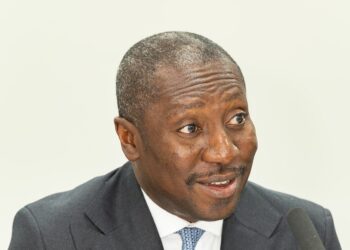
Former United Kingdom Deputy Prime Minister Dominic Raab has called for stronger enforcement against illegal gold mining and illicit gold trading, warning that criminal networks operating in the sector could undermine Ghana’s security as jihadist groups expand their activities from the Sahel towards coastal West Africa.
Mr Raab, who serves as a Special Envoy of the World Gold Council, said Ghana needed to tighten controls over the artisanal and small-scale mining sector to prevent criminal organisations from exploiting gold resources and supply chains for financial gain.
He argued that the country’s strategic location between the Sahel and the Gulf of Guinea made the fight against illegal mining a security priority that extended beyond environmental protection and the management of mineral resources.
Speaking to Bernard Avle on Channel One TV’s The Point of View on the sidelines of the Mining in Motion Summit 2026 in Accra, Mr Raab said Ghana faced overlapping threats from illegal mining and the southward expansion of extremist groups.
“Ghana is a fascinating country in many ways because you’re on the front line. You’ve got the galamsey problem; the President spoke about it. You also have JNIM and the jihadists looking from the Sahel down to the coast,” he said.
He warned that Ghana and Togo occupied a strategically important position in the coastal supply chains that extremist groups could seek to access.
“Ghana and Togo in the middle, you’re the access to the coastal supply chain they want, so there is a real risk, and it’s why we must win this struggle here,” he added.
Illegal gold trade raises security concerns
Mr Raab said illicit gold flows had implications for security because criminal and extremist organisations could exploit the trade to generate revenue and expand their operations.
He cited drug cartels in Latin America, Islamic State and al-Qaeda-linked groups in the Sahel, and mercenary organisations as examples of actors associated with criminal activity and security risks surrounding illicit gold.
According to him, rising gold prices have increased the financial incentives for criminal groups to enter or expand their activities in the sector, while efforts to control illegal mining and trading have struggled to keep pace.
He called for stronger law enforcement and measures to disrupt illicit financial flows, arguing that authorities must target the networks that profit from illegal gold rather than focus exclusively on mining activities at the extraction sites.
The warning places renewed emphasis on the links between mineral governance, financial transparency and national security, particularly as West African countries confront persistent threats from violent extremist groups.
Formal gold markets seen as part of the solution
Mr Raab also advocated the development of transparent and commercially viable supply chains that would allow responsible small-scale miners to sell their gold legally.
He said Ghana’s efforts to establish local gold-processing initiatives and gold-purchasing arrangements involving the central bank could help reduce miners’ dependence on criminal intermediaries.
A reliable formal market, he argued, would provide legitimate miners with better opportunities to sell their output while making it more difficult for illicit operators to move gold through unregulated channels.
Such arrangements could also improve traceability, helping authorities establish the origins of gold entering the market and identify suspicious transactions.
Mr Raab stressed that formalising the sector must be accompanied by effective enforcement to prevent criminal networks from exploiting weaknesses in the gold supply chain.
Call for greater international urgency
The former UK Deputy Prime Minister urged the international community to act more decisively against illicit gold trading, warning that failure to address the problem could worsen security threats and deprive governments of revenue.
His remarks highlight the need for cooperation among governments, law enforcement agencies, financial institutions and the gold industry to identify and disrupt networks involved in illegal extraction and trade.
For Ghana, the challenge extends beyond protecting forests and water bodies from the effects of illegal mining. It also involves ensuring that the country’s gold resources do not become a source of financing for criminal organisations or a means through which extremist groups gain access to regional markets.
Mr Raab’s central argument is that stronger enforcement, transparent gold purchasing and accessible legal markets for small-scale miners must work together to address the economic networks that sustain illicit mining and potentially contribute to wider security risks.