The government’s decision to repeal the electronic transaction levy (e-levy) has fulfilled one of the strongest demands expressed by Ghanaians ahead of the December 2024 elections.
The move, which President John Dramani Mahama signed into law on Wednesday, reflects overwhelming public opposition to the levy and aligns with campaign promises made by both major political parties.
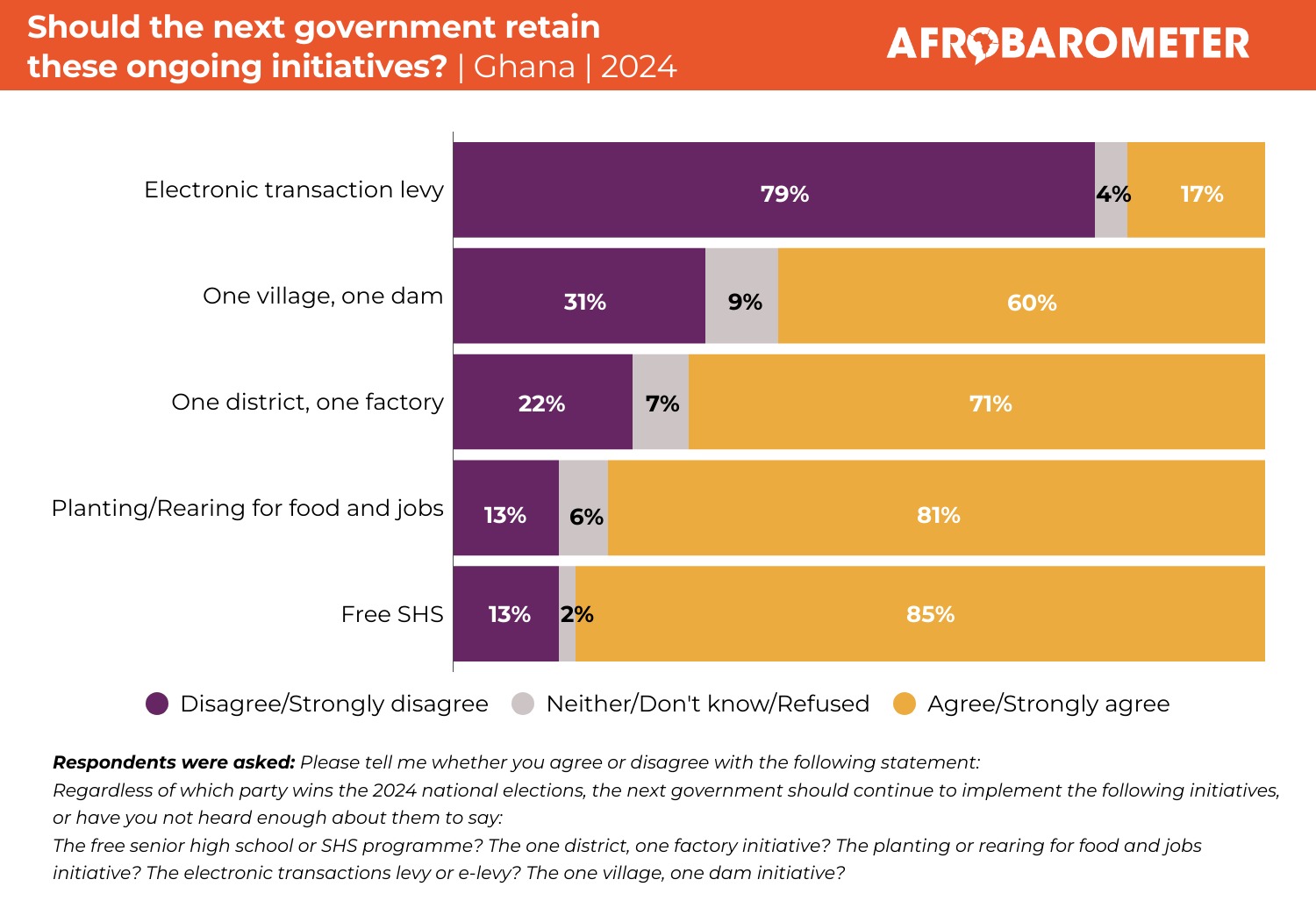
A recent Afrobarometer survey conducted in August 2024 found that 79% of Ghanaians favored discontinuing the e-levy, citing concerns over its financial burden and doubts about the government’s ability to use the revenue effectively for development projects.
The levy, introduced in May 2022, had been widely criticized for disproportionately affecting ordinary and low-income citizens.
Alongside the e-levy repeal, the new administration has also abolished an emissions tax and a betting tax, demonstrating a shift toward policies that prioritize economic relief for citizens.
The decision comes as part of the 2025 budget adjustments aimed at easing financial pressures on the public.
Public Support for Policy Changes
While opposition to the e-levy was strong across demographic groups, it was especially pronounced among men (83%), youth (83%), the poorest citizens (86%), and those with post-secondary education (87%). In the 2022 Afrobarometer survey, 76% of respondents believed the levy was a poor policy decision due to its impact on lower-income individuals, and nearly two-thirds (63%) expressed strong doubts about the government’s ability to channel the revenue into meaningful development.
Despite their opposition to the e-levy, Ghanaians continue to support other key government initiatives.
The survey found strong approval for the Free Senior High School program (85%), the Planting for Food and Jobs initiative (81%), the One District, One Factory policy (71%), and the One Village, One Dam project (60%).
Survey Findings and Research Credibility
The Afrobarometer survey, conducted by the Ghana Center for Democratic Development, interviewed 2,400 adult Ghanaians face-to-face, providing nationally representative results with a margin of error of +/-2 percentage points at a 95% confidence level.
With the repeal of the e-levy, the Mahama administration has taken a significant step toward addressing public concerns.
As the December 2024 elections approach, this policy shift signals the government’s responsiveness to the economic priorities of Ghanaians, potentially influencing voter sentiment in the upcoming polls.