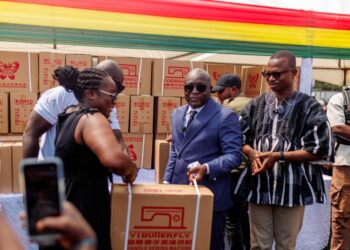
As part of this year’s Eluo Festival, Nana Kwasi Aduhene II, Chief of Sefwi Kofikrom, has demonstrated a profound commitment to human development by spearheading health and education-focused interventions that have left a lasting impression on the Juaboso District.
In a significant gesture aimed at improving healthcare access, the traditional leader registered 1,824 residents onto the National Health Insurance Scheme (NHIS), covering both new registrants and renewals. Of the total, 617 people received new NHIS cards, while 1,207 had their subscriptions renewed—offering relief to families burdened by out-of-pocket medical expenses.
Speaking during the exercise, Nana Aduhene II described the initiative as part of his broader mission to ensure that no member of his community is denied healthcare due to financial constraints. He appealed to philanthropic individuals and organisations within the Juaboso District and beyond to replicate such interventions, noting the urgency of collective action in improving rural health outcomes.
But the chief’s Eluo Festival outreach did not stop at healthcare.
In a bid to nurture academic excellence and boost motivation among young learners, Nana Aduhene II also organised a quiz competition involving Junior High Schools from Kofikrom, Proso, Akwasi Addaikrom, Elumbo, and Adiembra. The event, which drew community participation and excitement, was designed to foster healthy competition and improve learning outcomes.
Addressing the schoolchildren, he urged them to take their education seriously, show respect to their teachers, and aim high in pursuit of their dreams. “Education remains the key to transforming lives and building strong communities,” he said.
Nana Aduhene II’s dual investment in health and education is being hailed as a model of traditional leadership rooted in social responsibility—offering a powerful reminder of how festivals can be used not only to celebrate culture but also to drive impactful development.