
















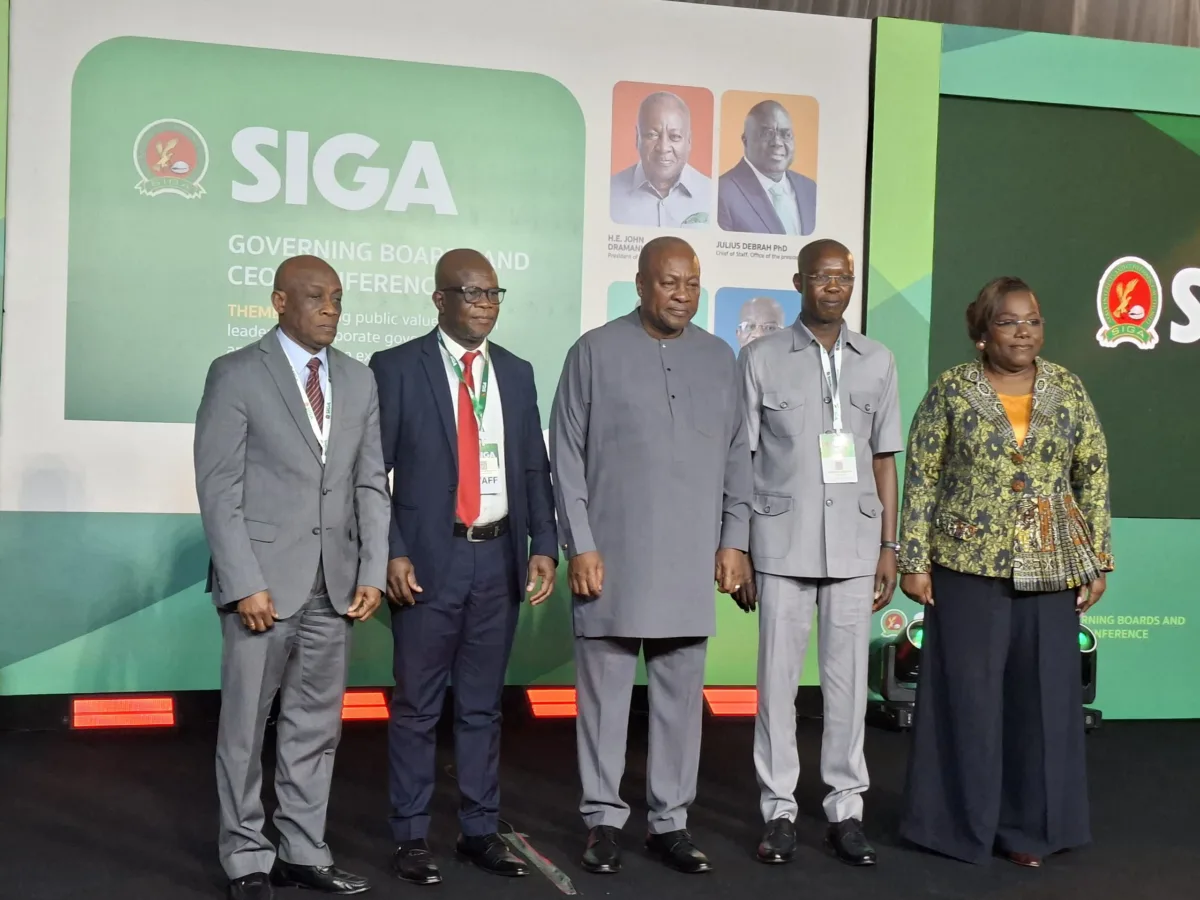
The Director-General of the State Interests and Governance Authority (SIGA), Professor Michael Kpessa-Whyte, has challenged State-Owned Enterprises (SOEs) to convert their improved financial performance into tangible benefits for the Ghanaian public.
He said profitability alone could not be considered a measure of success unless state enterprises also delivered dividends to government, strengthened governance and improved accountability.
Prof. Kpessa-Whyte made the call at the 2026 Governing Boards and CEOs Conference in Accra on Wednesday, where boards and chief executives reviewed the performance of state enterprises during the 2025 financial year.
His comments followed a significant improvement in the financial performance of the SOE sector, with the 2025 State Ownership Report recording a net profit after tax of GH¢19 billion.
The report indicated that 34 of the 53 SOEs assessed were profitable, while total revenue rose to GH¢176.4 billion, representing a 28.2 per cent increase over the previous year.
Prof. Kpessa-Whyte attributed the improved results not only to better economic conditions but also to stronger management and governance practices within some state enterprises.
He said the figures demonstrated that disciplined cost management, improved control of receivables and the effective use of performance contracts could significantly improve the fortunes of public institutions.
“The results reflect more than favourable external conditions. They show what can happen when boards stay close to the fundamentals, when management controls costs and receivables, and when performance contracts guide decisions throughout the year,” he said.
He pointed to the performance of several entities as evidence that sustained profitability was achievable when state institutions were properly governed.
According to the report, the infrastructure subsector recorded its first sector-wide operating profit in five years, while the Ghana Gold Board recorded a net profit of GH¢896.52 million in its first year of operation.
Ten SOEs, led by the Ghana National Petroleum Corporation (GNPC) and the Ghana Ports and Harbours Authority (GPHA), also maintained profitability for five consecutive years.
Prof. Kpessa-Whyte said the consistent performance showed that effective governance could produce lasting results.
“What this tells us is that consistency is possible when institutions are governed well,” he said.
However, he warned that strong balance sheets and rising profits would have limited significance if the financial gains did not ultimately benefit the state and citizens.
“A profit that never reaches the shareholder has not yet become public value,” he said.
He disclosed that only two SOEs — Ghana Reinsurance Company and Tema Development Company (TDC) — paid dividends to the government from their 2024 operations.
He, however, commended BOST Energies for declaring and paying dividends from its 2025 operations, describing it as an example of how improved profitability could translate into direct returns for the state.
Beyond financial performance, the SIGA Director-General expressed concern over compliance gaps among some specified entities.
He said only 72 entities signed performance contracts in 2025, while 71 submitted their quarterly reports on time.
Only 37 entities, he added, held annual general meetings or stakeholder meetings during the period.
Prof. Kpessa-Whyte therefore urged boards and chief executives to take greater responsibility for improving compliance, transparency and accountability across the state enterprise sector.
“Boards and chief executives shape performance through the quality of their decisions, the accuracy of information they demand, and the speed with which they address risks,” he said.
He expressed the hope that subsequent State Ownership Reports would reflect not only higher profits but also stronger compliance, improved governance and greater public value from all specified entities.






