
















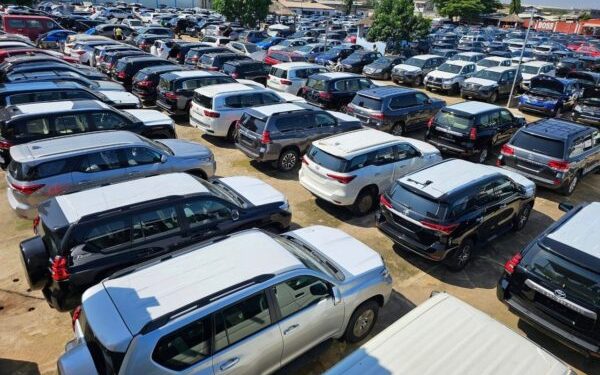
The Vehicles and Assets Dealers Union of Ghana (VADUG) is calling for urgent government intervention, warning that local vehicle dealers are losing ground as Chinese automobile companies expand their presence across Ghana’s automotive market.
Addressing a press conference in Accra on Thursday, June 11, 2026, VADUG President Bernard Ntrakwa said local dealers are struggling to compete with Chinese manufacturers and assemblers who benefit from incentives under Ghana’s automotive policy while also participating directly in vehicle retailing.
According to the union, indigenous dealers importing used vehicles from markets in the United States, Europe and Japan are required to pay between 35 and 50 per cent in taxes and duties, whereas companies importing semi-knocked-down (SKD) and completely knocked-down (CKD) vehicle kits enjoy significant duty exemptions.
VADUG argues that the imbalance has created an unfair competitive environment, enabling Chinese brands to rapidly increase their market share while leaving locally imported vehicles unsold for longer periods.
“We do not oppose foreign investment, but the current situation is becoming increasingly difficult for local dealers and the thousands of workers who depend on the industry,” the union stated.
The association also questioned the growing involvement of Chinese automobile companies in both wholesale and retail operations, noting that many global brands traditionally operate through independent local dealership networks rather than directly selling vehicles to consumers.
Beyond competition concerns, VADUG warned that Ghana could become a destination for ageing petrol and diesel-powered vehicles as China accelerates its shift toward electric vehicle production and reduces its reliance on internal combustion engine technology.
The union called on regulatory bodies, including the Ghana Standards Authority (GSA), the Driver and Vehicle Licensing Authority (DVLA), and the Ghana Investment Promotion Centre (GIPC), to strengthen oversight to prevent the importation of substandard vehicles.
VADUG further urged government to review current tax and duty policies to ensure a level playing field, while introducing stronger vehicle safety, warranty and quality standards across the industry.
The union also appealed for financial support and capacity-building programmes for local dealers through institutions such as the Ghana EXIM Bank to help indigenous businesses remain competitive.
In addition, VADUG criticised the AI Publican customs valuation system, claiming it has increased import costs by assigning what it describes as excessively high values to imported vehicles, resulting in higher duties for dealers.
The union is therefore calling for stakeholder consultations with the Ghana Revenue Authority and government officials to explore reforms, including a flat-rate duty system for vehicles and spare parts to improve transparency and predictability within the automotive sector.






