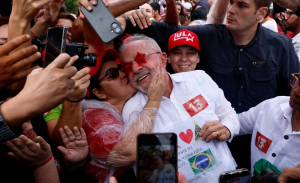
The legal saga of Brazil’s former president Jair Bolsonaro is fast becoming more than a domestic courtroom drama, morphing into a flashpoint of international political solidarity and friction, particularly among right-wing populist figures and institutions.
On Monday, Brazil’s Supreme Court placed Bolsonaro under house arrest for allegedly violating previous court-imposed restrictions while facing trial over an alleged coup plot—an accusation the former president vehemently denies. The move came after Supreme Court Justice Alexandre de Moraes accused Bolsonaro of exploiting social media networks—including those of his political allies and family—to circumvent judicial restrictions and influence public opinion.
Among the violations cited was a recent incident where Bolsonaro’s son, Senator Flávio Bolsonaro, placed his father on speakerphone during a pro-Bolsonaro rally in Rio de Janeiro. The video was later deleted, but Justice Moraes referenced it as evidence of “deliberate defiance” of the court’s earlier directives.
“The flagrant disregard for the preventative measures was so obvious that – it bears repeating – the defendant’s own son… deleted the post to conceal the legal transgression,” Moraes wrote, tightening restrictions to ban Bolsonaro from receiving visitors (except lawyers or court-approved individuals) and from using a mobile phone in any form.
Yet the court’s actions have triggered sharp reactions outside Brazil—particularly from Bolsonaro’s allies abroad.
Former U.S. President Donald Trump, who shares a longstanding political kinship with Bolsonaro, used the developments as fresh ammunition in his own campaign against what he calls “judicial overreach.” In an unprompted move, Trump cited Bolsonaro’s trial as justification for imposing sweeping 50% tariffs on selected Brazilian goods, despite the U.S. currently enjoying a trade surplus with the South American nation.
Trump also described Bolsonaro as “not guilty of anything,” framing him as a victim of a global “witch-hunt” against conservative leaders. The pair previously enjoyed warm relations during their overlapping terms, with Bolsonaro being one of the few world leaders to openly endorse Trump’s 2020 re-election bid.
In a surprising twist, the U.S. State Department has also weighed in—though in a seemingly contradictory tone. A statement issued via X condemned the Brazilian court order, pledging to “hold accountable all those aiding and abetting sanctioned conduct.” The vague phrasing has raised questions about whether Washington’s stance aligns more with Bolsonaro’s camp or reflects a broader critique of judicial activism in politically sensitive cases.
Justice Moraes, who himself has been sanctioned by the U.S. for what officials described as anti-democratic conduct, responded with forceful rhetoric, warning that the judiciary would not be intimidated by political muscle or international alliances.
“Justice is blind, but it is not foolish,” he wrote. “We will not allow a defendant to make a fool of the court simply because he wields political or economic power.”
While Bolsonaro’s legal team has denied any wrongdoing and promised to appeal the house arrest order, the political and diplomatic aftershocks are only beginning. Pro-Bolsonaro rallies across Brazil on Sunday were attended by thousands, with many portraying the court’s actions as an attack on democracy itself.
Analysts say the affair has morphed into a litmus test for Brazil’s judiciary and a symbol of the broader ideological struggle between traditional legal institutions and a growing tide of populist, anti-establishment forces worldwide.
With the next hearing set for later this year, Bolsonaro’s fate may no longer rest solely in the hands of Brazil’s highest court—but in the volatile court of global political opinion.