
















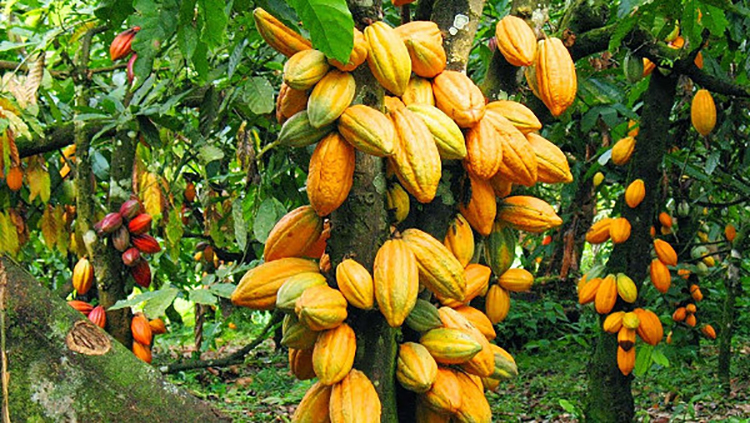
Ghana’s dependence on raw cocoa exports is coming under renewed scrutiny as declining international prices, slowing sector growth and production risks threaten one of the country’s most important sources of export earnings.
With global cocoa prices retreating from their early 2025 highs and the Ghana Cocoa Board (COCOBOD) projecting a further decline in production in the 2026/2027 crop season, concerns are mounting over the country’s ability to protect its cocoa revenues without accelerating efforts to process more of the commodity locally.
International cocoa prices, which climbed to approximately US$10,000 per metric tonne in early 2025, have since declined significantly, trading between US$5,420 and US$5,447 as of Tuesday.
The decline presents a major challenge for Ghana, whose cocoa sector remains heavily exposed to fluctuations in the international commodity market.
The pressure is being compounded by signs of weakening growth in the sector. Data from the Ghana Statistical Service show that cocoa-sector growth slowed to 5.2 per cent in the second quarter of 2026, compared with 14.2 per cent during the corresponding period a year earlier.
Production prospects are also becoming increasingly uncertain.
COCOBOD is projecting at least a 16 per cent decline in cocoa output during the 2026/2027 crop season, citing threats including unfavourable weather conditions, swollen shoot disease, ageing cocoa farms and illegal mining activities.
The Ghana Meteorological Agency has also warned that a very strong El Niño event could disrupt agriculture, water resources and hydroelectric power generation during the 2026/2027 period.
For an agricultural sector already facing production challenges, the anticipated weather conditions could further complicate efforts to sustain output and protect farmers’ incomes.
Local processing offers alternative revenue opportunities
Against this backdrop, increasing domestic cocoa processing is emerging as an important strategy for reducing Ghana’s exposure to raw commodity price fluctuations.
Ghana has set a target of processing at least 50 per cent of its cocoa domestically, supported by an installed grinding capacity exceeding 500,000 metric tonnes.
The objective is to retain a greater share of the value generated from cocoa production through the manufacturing of cocoa butter, cocoa powder, cocoa liquor, chocolate and other finished products.
The potential benefits extend beyond export earnings to include industrial development, employment creation, technology transfer and stronger participation of local businesses in international value chains.
There are already indications that value addition can contribute significantly to Ghana’s export performance.
Non-traditional exports reached a record US$5 billion in 2025, with processed and semi-processed products accounting for US$3.9 billion.
The figures highlight the growing importance of value-added products in diversifying the country’s export base and strengthening its capacity to earn foreign exchange.
However, the broader agro-processing industry continues to face structural challenges.
The cashew sector, for instance, processes less than 10 per cent of locally produced raw cashew, leaving a substantial portion of the potential value from the commodity to be realised outside the country.
This underscores the difficulties associated with building competitive domestic processing industries, including financing constraints, technology gaps, production costs and access to reliable markets.
The challenge of moving beyond raw exports
For Ghana’s cocoa industry, the challenge is no longer simply about expanding processing capacity but ensuring that existing facilities operate efficiently and remain commercially competitive.
Achieving the 50 per cent domestic processing target will require consistent access to raw beans, reliable energy supply, investment in modern processing technology and policies that support local manufacturers.
It will also require stronger linkages between cocoa farmers, processors and export markets to ensure that value addition translates into tangible benefits across the production chain.
Ultimately, the combination of falling international prices, production uncertainties and slowing sector growth is reinforcing the need for Ghana to reconsider its traditional dependence on raw cocoa exports.
The country’s ability to turn more of its agricultural commodities into finished and semi-finished products could prove critical to securing higher export earnings, creating jobs and building resilience against external market shocks.






