
















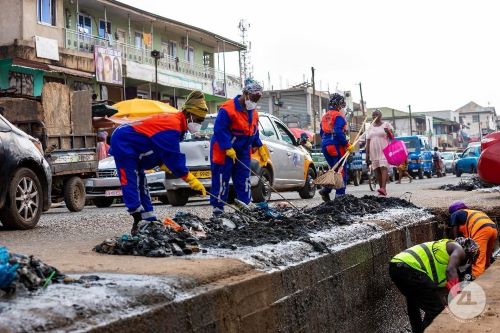
What began as a commitment to keeping communities clean has turned into a prolonged struggle for survival for dozens of sanitation workers employed by Zoomlion Ghana Limited in the Atebubu-Amantin Municipality. After nearly two years of unpaid wages, the workers—mostly women—are now pleading with the government to intervene.
In a press conference held in Atebubu, the municipal capital, the aggrieved workers painted a grim picture of their daily reality—one marked by hunger, broken homes, and rising despair. Despite continuing to sweep streets and manage waste to maintain public hygiene, they say their labour has gone unrewarded for 20 months.
Madam Alice Osei, who spoke on behalf of the group, did not mince words. “We are not lazy. We work every day to keep Atebubu and its surrounding communities clean. But for 20 months, we haven’t received a cedi in salaries,” she said.
A respected voice in the community and known as the Vegetable Queen of the Atebubu Market, Madam Osei revealed that the situation has become unbearable, especially for single mothers. “We can’t pay our children’s school fees. Some of us can’t afford a decent meal. Our marriages are suffering because we have nothing to contribute at home,” she lamented.
The workers accuse Zoomlion of turning a blind eye to their plight despite multiple appeals and follow-ups for payment. They are now appealing directly to the government for intervention, arguing that only state pressure can compel the company to act.
“We have reached a point where only government action will force the company to take us seriously,” Madam Osei said. “We are not asking for handouts — just what is rightfully owed to us for the work we’ve already done.”
The sanitation workers’ call comes at a time when Ghana is grappling with widespread economic pressures, and labour disputes across sectors are becoming increasingly common. But the situation in Atebubu stands out for one reason: these workers have refused to down tools.
“We are still at post,” said Madam Osei. “We love our communities, and we won’t let them drown in filth. But we can’t be invisible anymore.”
As pressure mounts on both Zoomlion and the government, the Atebubu sanitation workers are hoping their cries will finally be heard — not just as employees, but as mothers, breadwinners, and citizens demanding dignity and fairness.






