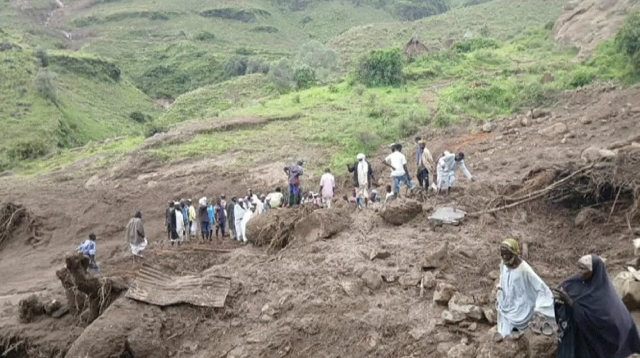
Efforts to reach survivors of a devastating landslide in Sudan’s Marra Mountains are being slowed by war, heavy rains, and treacherous terrain, UN officials and local rescue teams have warned.
The disaster, which struck the remote village of Tarseen in Darfur after days of torrential rain, is believed to have killed hundreds of people. While estimates of the death toll vary widely—from 370 reported by the UN to as many as 1,000 claimed by the Sudan Liberation Movement/Army (SLM/A)—humanitarian workers say the biggest challenge now is access.
“We do not have helicopters, everything goes in vehicles on very bumpy roads. It takes time and it is the rainy season—sometimes we have to wait hours, maybe a day or two to cross a valley,” said Antoine Gérard, the UN’s deputy humanitarian coordinator for Sudan.
Local rescue teams say their efforts are overwhelmed. Abdul Hafeez Ali, head of the Coordinating Council of the Tawila and Jebel Marra Emergency Room, admitted that operations were severely constrained by limited resources and relentless rain. “We have not been able to carry out full-scale rescue operations,” he said, adding that Tarseen had been home to about 300 families.
The UN has activated its emergency response, sending tents, food, water, and medical supplies, with plans to airlift teams into the affected region. “We hope to provide immediate assistance over the next few hours and days to come,” said Luca Renda, acting UN Resident and Humanitarian Coordinator in Sudan.
But the conflict that has raged since April 2023 between Sudan’s army and the paramilitary Rapid Support Forces (RSF) has left Darfur deeply fractured, with humanitarian access restricted and millions displaced. The Marra Mountains, long seen as a place of refuge, are now cut off from most international aid.
Darfur’s governor, Minni Minnawi, described the event as a “humanitarian tragedy” beyond the capacity of local communities to manage. He appealed to global organisations to intervene urgently.
The African Union has echoed that call, urging both warring parties to pause hostilities and allow aid to flow. “Silence the guns and unite in facilitating the swift delivery of assistance,” said AU Commission head Mahmoud Ali Youssouf.
For survivors in Tarseen, however, the immediate concern is survival. With only a handful of bodies recovered so far and hundreds still missing, rescuers say time is running out.