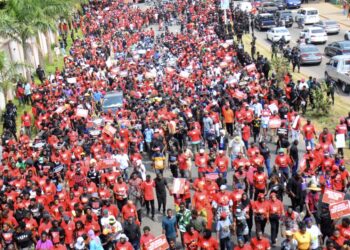
At a candlelight vigil in Accra’s Revolution Square on Sunday evening, the voice that moved the crowd most was not that of a politician, activist, or celebrity—but of a young boy.
Identifying himself simply as “DD”, short for Desperate Desmond, the child stood before hundreds gathered for the anti-galamsey vigil and poured out fears of a future poisoned by polluted rivers and destroyed wildlife.
“I am desperate because of galamsey,” he said, his voice trembling. “If we drink the galamsey water, we will die. I am too young to die, I want to live long.”
His emotional appeal came ahead of a planned march against illegal mining, which has devastated water bodies, farmland, and rural communities across Ghana.
The boy’s words resonated deeply, turning him into the unexpected face of a struggle that has long been dominated by experts and civil society leaders.
He warned that the destruction of rivers was not only threatening human life but also erasing Ghana’s biodiversity. “We have a lot of animals, nice fishes, but if the galamsey water spoils them, we won’t even see fish to eat. We can’t even swim in the water bodies again,” he lamented.
The vigil also drew attention to mounting frustrations with authorities. Protesters accused leaders of failing to confront the illegal mining menace, despite its human and environmental toll.
As the gathering ended, chants of “Stop galamsey now! Protect the children!” echoed through the square—words first spoken by a child but now amplified by an entire movement.