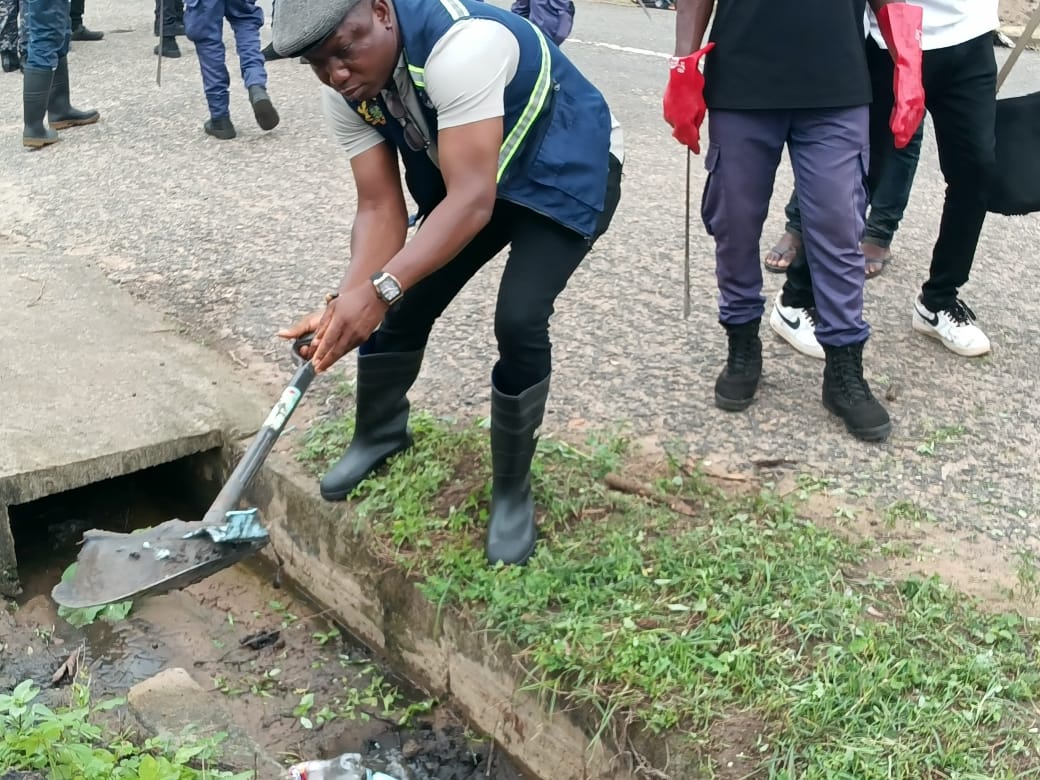
The District Chief Executive (DCE) for Adaklu, **Jerry Yao Ameko**, has called on Ghanaians to adopt responsible sanitation practices, warning that without a change in attitude, clean-up exercises alone will not solve the country’s environmental challenges.
He said the recent devastating floods across the country should serve as a wake-up call for citizens to stop indiscriminate dumping of refuse and avoid building on waterways.
Mr Ameko made the remarks during a massive clean-up exercise at Adaklu Waya, the district capital, where hundreds of workers from the District Assembly, decentralised departments, the Ghana Police Service and the Ghana National Fire Service joined hands to improve sanitation in the municipality.
The participants cleared a large refuse dump near the Adaklu Waya Market, weeded public spaces and desilted gutters to improve drainage and reduce the risk of flooding.
Joining the exercise were the Adaklu District Environmental Health Officer (DEHO), Mrs Stella Vidzro, Assistant Superintendent of Police Esther Buakuma, and the Adaklu District Fire Officer, Mr Stephen Toffa.
Addressing participants, Mr Ameko stressed that environmental cleanliness should become a daily habit rather than an occasional activity.
“Without attitudinal change, the debris we cleared today will come back to haunt us,” he said.
He urged residents to allow their conscience to guide them in maintaining clean surroundings through proper waste disposal, regular clearing of drains and responsible environmental practices.
The DCE noted that the enormous financial resources spent by government each year on responding to flood-related disasters could instead be invested in development projects if communities embraced proper sanitation.
He therefore appealed to the public to participate actively in communal clean-up exercises and support efforts to keep communities clean and healthy.
Mrs Stella Vidzro also underscored the importance of environmental cleanliness, describing it as essential to public health and improved quality of life.
She explained that clean surroundings reduce the spread of diseases such as malaria, typhoid and cholera by limiting exposure to harmful bacteria, viruses and other disease-causing organisms.
The Environmental Health Officer encouraged residents to extend sanitation practices beyond their homes to markets, streets and other public spaces.
Mrs Vidzro further warned that the District Assembly would strictly enforce its sanitation by-laws and prosecute individuals who violate environmental regulations.
The clean-up exercise formed part of efforts to promote environmental sanitation, improve public health and reduce the risk of flooding in the Adaklu District.