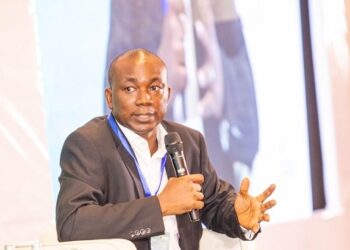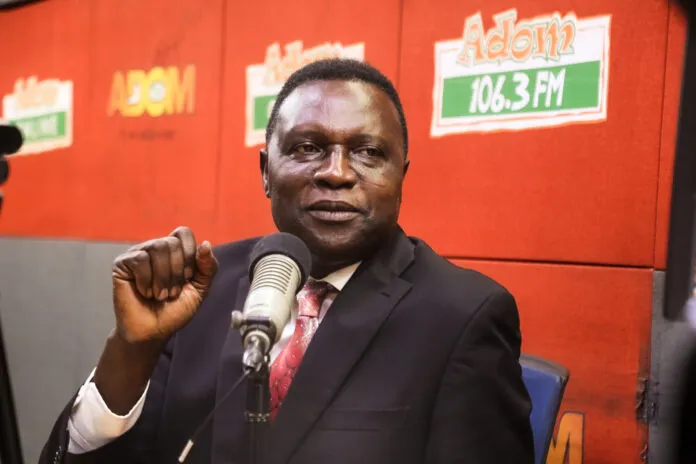
Former Education Minister Dr Yaw Osei Adutwum has challenged criticisms of Ghana’s double-track education system, arguing that improvements in academic performance after its introduction provide evidence that the policy did not undermine educational outcomes.
Dr Adutwum said the debate around double-track had largely been politicised, resulting in insufficient attention being paid to data and the experiences of schools that operated under the system.
“It was misconstrued, bastardized, politicized,” he said.
He cited Presbyterian Boys’ Secondary School (PRESEC), saying the school was able to admit about 500 additional students under the double-track arrangement while recording improved academic performance.
Achimota School, he added, also maintained its academic performance after adopting the system, contradicting claims that the policy necessarily weakened standards.
Dr Adutwum said his assessment of the system was also influenced by his personal experience of teaching in a double-track school in the United States for 10 years.
He further referenced the Brookings Institution, which he said had described Ghana’s double-track programme as one of Africa’s innovative education initiatives.
According to the former minister, available academic data before and after the introduction of Free Senior High School (Free SHS) and double-track should form an important part of the national assessment of the policy.
He said in 2015, before the introduction of Free SHS and double-track, the pass rates were 45.2 per cent in English, 28.7 per cent in Integrated Science and 32.4 per cent in Mathematics.
For the first double-track cohort examined in 2020, he said, the figures had risen to 57.34 per cent for English, 52 per cent for Integrated Science and 65 per cent for Mathematics, while Social Studies recorded 64 per cent.
By 2023, English had recorded a pass rate of 73 per cent, Integrated Science 66 per cent, Mathematics 62 per cent and Social Studies 76 per cent, he said.
Dr Adutwum argued that the figures demonstrated the need for a more evidence-based evaluation of the policy rather than relying primarily on political arguments.
“Politicians are our own worst enemies,” he said, suggesting that partisan debates had sometimes made it difficult to objectively examine developments within Ghana’s education sector.