
















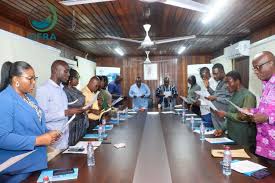
The Fisheries Commission has established two national committees to help translate scientific research and technical advice into coordinated action for the sustainable management of Ghana’s fisheries resources.
The Scientific and Technical Committee (STC) and the Fisheries Management Operational Committee (FMOC) were inaugurated separately at the Fisheries Commission Conference Room in Accra on Wednesday, September 23.
The new structures are expected to strengthen collaboration between scientists, government agencies and fisheries stakeholders while improving the implementation of management decisions.
The initiative is being supported by Global Fisheries and Resilience Action (GFRA) under the Inshore Exclusion Zone Enforcement and Transparency (IEZET) Project.
The inauguration forms part of efforts to bring Ghana’s fisheries co-management arrangements in line with the Fisheries and Aquaculture Act, 2025 (Act 1146).
Under Sections 11 and 13 of the Act, the Governing Board of the Fisheries Commission has powers to establish committees, including co-management committees, to support the effective management of fisheries resources.
Professor Benjamin Campion, Executive Director of the Fisheries Commission, outlined the governance framework under the new legislation and explained the respective responsibilities of the Governing Board, the Commission and the Ministry of Fisheries and Aquaculture.
Chairman of the Governing Board, Professor Wisdom Akpalu, said the committees would provide an important platform for evidence-based and participatory decision-making within the fisheries sector.
He urged members of the committees to carefully examine scientific and technical recommendations submitted to them to ensure that management decisions support the long-term sustainability of fisheries resources.
The STC, chaired by Dr Angela Lamptey, will serve as the Commission’s scientific and technical advisory body.
Its mandate has been broadened beyond marine fisheries to include inland fisheries and aquaculture, allowing scientific considerations across the sector to feed into national fisheries management decisions.
The FMOC, chaired by Mr Daniel Owusu, will focus on turning scientific recommendations into practical and coordinated implementation.
Mr Owusu said the Committee would develop annual implementation plans and coordinate the activities of relevant divisions of the Fisheries Commission and other stakeholder institutions.
The two committees will therefore operate as complementary structures, with the STC providing scientific and technical guidance and the FMOC helping to translate that guidance into operational measures.
The arrangement is expected to improve coordination and create a stronger link between research, policy decisions and implementation in Ghana’s fisheries sector.
The committees will also provide opportunities for government institutions, technical experts and fisheries stakeholders to collaborate on measures aimed at protecting and sustainably managing fisheries resources.
The development comes as Ghana strengthens the implementation of provisions under the Fisheries and Aquaculture Act, including measures relating to enforcement of the extended Inshore Exclusion Zone and transparency in fisheries management.
GFRA is implementing the IEZET Project in partnership with the Environmental Justice Foundation and Hen Mpoano to support these measures and strengthen community resilience and sustainable fisheries management.
The establishment of the two committees is consequently expected to give Ghana’s fisheries management system a more structured mechanism for connecting scientific evidence with coordinated action on the ground.






