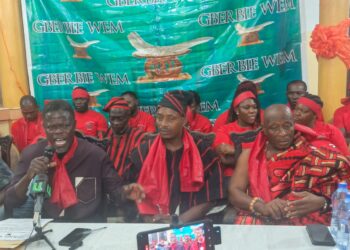
Women in northern Ghana are being equipped with skills to identify, challenge and report corruption under a new initiative aimed at strengthening community-level accountability.
The Centre for Social Mobilisation and Sustainable Development (CENSODEV) has launched the Northern Ghana Women Anti-Corruption and Leadership Initiative (NG-WALI) at Paga in the Kassena Nankana West District.
The initiative seeks to build the capacity of women to become active participants in promoting transparency and good governance within their communities and local government structures.
Executive Director of CENSODEV, Braimah Sanjage, said the impact of corruption extended beyond the misappropriation of public funds.
He said corruption could also result in stolen opportunities, denial of essential services and the erosion of public trust.
According to him, women were particularly exposed to the effects of corruption because many serve as household managers, caregivers and operators of small businesses.
He said empowering women with knowledge of their rights and the confidence to speak out would therefore strengthen community efforts to demand accountability.
Mr Sanjage said NG-WALI would build on CENSODEV’s existing Social Audit Committees in the Kassena Nankana Municipality and Kassena-Nankana West District by creating a network of women committed to monitoring accountability.
The project forms part of CENSODEV’s broader efforts to promote women’s participation in local governance, support women entrepreneurs and encourage their involvement in electoral processes.
Women encouraged to report abuse
Kassena-Nankana West District Chief Executive, Stephen Aeke Akurugo, said corruption affected residents in their daily activities, citing alleged illegal levies on traders, demands for unofficial payments for healthcare services and sexual exploitation linked to access to services.
He said women could be particularly vulnerable because of their responsibilities as caregivers, household managers and small-scale entrepreneurs.
Mr Akurugo said equipping women to understand their rights and report abuses could have wider benefits for households and communities.
He pledged the Assembly’s support for the initiative and described good governance as a shared responsibility between public institutions and citizens.
The DCE urged participants to use established legal and institutional mechanisms to report suspected corruption, including the Whistleblower Act, the Office of the Special Prosecutor, the Economic and Organised Crime Office, the Police, traditional authorities and the Commission on Human Rights and Administrative Justice.
Mr Sanjage also called on traditional leaders, civil society organisations, the District Assembly and the media to support efforts to amplify women’s voices in the fight against corruption.
He appealed to donors and development partners to support NG-WALI, which is being implemented as a matching-fund initiative with backing from the West Africa Civil Society Institute (WACSI) and WILDE-GANZEN.