
















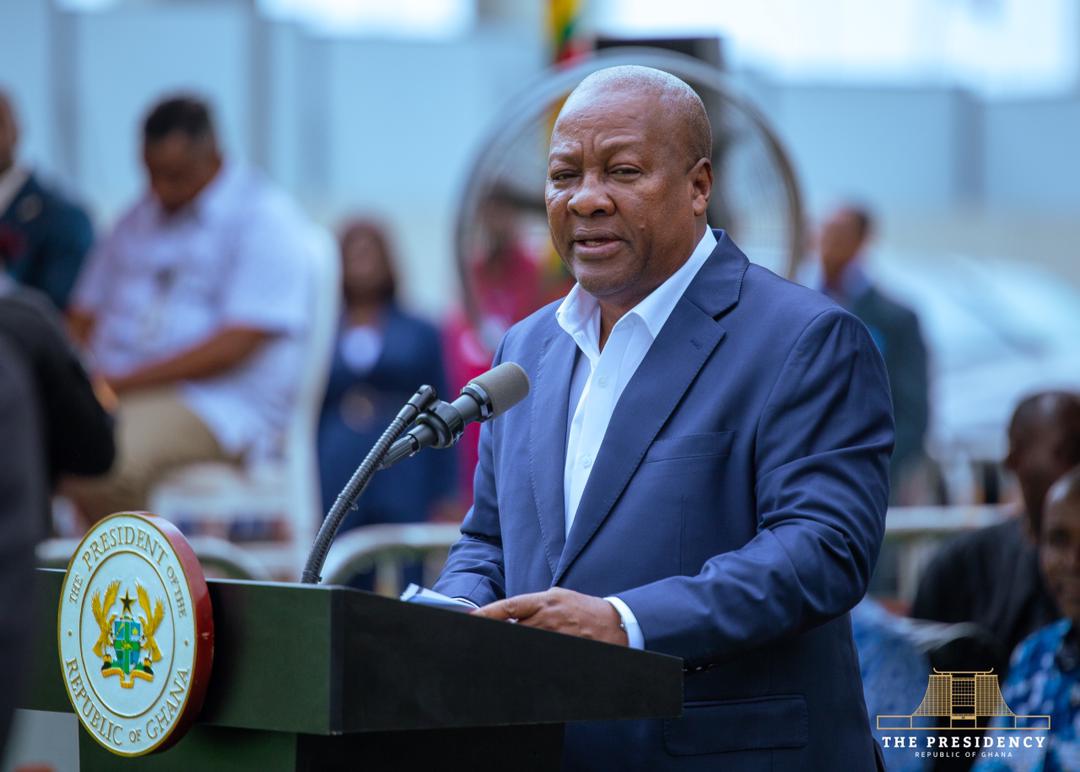
President John Mahama has described Nestlé Ghana’s expansion of its evaporated milk production line as a sign of renewed investor confidence in Ghana’s economy and the gradual revival of industrial activity in Tema.
He said the increase in investments was being supported by improving macroeconomic conditions, including lower inflation, declining interest rates and a stronger Ghanaian cedi.
Speaking on Thursday, October 8, at the commissioning of the expanded production line in Tema, President Mahama said foreign direct investment (FDI) had increased significantly from US$624 million in 2024 to US$2.62 billion in 2025.
He said the increase demonstrated growing confidence in Ghana as a destination for long-term investment.
The President said Nestlé’s decision to expand its operations in Tema was particularly significant because it showed that companies were prepared to commit additional capital as economic conditions improved.
“This is because the investment climate is good,” he said.
According to President Mahama, the renewed investment activity is also helping Tema regain its position as one of Ghana’s major industrial centres.
“I’m pleased to say that Tema is regaining its glory days,” he said.
Tema industrial revival
President Mahama cited developments across the Tema industrial enclave, including the expansion of the Tema Port and the resumption of operations at the Tema Oil Refinery.
He said the government was also working towards reviving the Volta Aluminium Company (VALCO), while existing companies in the enclave continued to expand their operations.
“The ports of Tema have expanded. Tema Oil Refinery is back at work again. We’re working on reviving VALCO. The industrial enclave is progressing, and many industries like Nestlé existing in the Tema enclave are expanding their production,” he said.
The President linked the developments to what he described as a more stable economic environment, arguing that macroeconomic indicators were increasingly influencing corporate investment decisions.
Stability influencing investment decisions
President Mahama said inflation had declined from 23.8 per cent to about 5.2 per cent, while interest rates were also falling, with spreads ranging between 9 and 13 per cent.
He further said the cedi had regained strength after a prolonged period of depreciation.
“And our long-suffering local currency, the cedi, has regained its strength and is relatively performing very well,” he said.
He stressed that the significance of these developments went beyond headline economic figures, noting that stability could determine whether companies proceeded with or postponed expansion plans.
“I do not recite these figures for their own sake because stability is not a number in the report. It is a difference between a company that shelves an expansion and one that decides to go forward with investments,” he said.
He added that greater macroeconomic stability could give international companies and their boards more confidence to approve investments in Ghana.
“It helps a boardroom in Switzerland to take decisions to commit capital to Tema with greater confidence,” he said.
Currency risk remains
Despite the improved conditions, President Mahama acknowledged that businesses operating in Ghana continued to face currency-related risks.
“Businesses must still account for currency risk in their decisions,” he cautioned.
He said maintaining economic stability would therefore remain important if Ghana was to attract more long-term investment and encourage existing businesses to expand.
The President described Nestlé Ghana’s new production line as consistent with the industrialisation objectives of his administration’s Reset Agenda.
“The line before us is a welcome sign of Nestlé’s confidence in Ghana’s long-term prospects, and it aligns with the industrial ambitions of our Reset Agenda,” he said.
He said the expansion, alongside developments in the Tema industrial corridor, demonstrated the importance of restoring the enclave’s role as a major manufacturing and investment hub.
The government’s focus on Tema forms part of its broader effort to increase productive activity, attract foreign capital and create conditions for businesses to expand their operations in Ghana.






