
















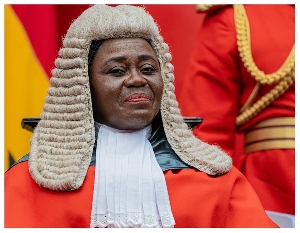
Former Attorney-General Martin Amidu has warned that any decision by President John Dramani Mahama to accept the resignation of Chief Justice Gertrude Araba Esaaba Sackey Torkornoo, after a prima facie case has been established against her, would undermine the constitutional process and violate his oath of office.
In a recent opinion piece, Amidu argued that accepting Torkornoo’s resignation at this stage would obstruct the constitutional rights of citizens to hold justices accountable through the Article 146 process, effectively blocking the inquiry before it reaches its conclusion.
“The President, as the recipient of such petitions, would be violating his constitutional oath if he were to accept the resignation of the Chief Justice after the determination of a prima facie case, the formation of an investigative committee, and her suspension,” Amidu wrote. “This would undermine the constitutional right of the petitioner to have their grievances heard, effectively cutting off the path to justice.”
Drawing on Historical Precedent
Amidu recalled a similar situation in 1998 involving Supreme Court Justice Kweku Etrew Amua-Sekyi, who resigned before a disciplinary committee could complete its work. He described this incident as a critical error, emphasizing that such a move sets a dangerous precedent for the rule of law.
“The only instance in Ghana’s history where a justice of the superior court was allowed to resign under similar circumstances was in 1998, when Justice Amua-Sekyi resigned after a prima facie case was established against him,” Amidu recounted.
At the time, Justice Isaac Kobina Abban had filed a petition against Justice Amua-Sekyi, which led to the formation of an investigative committee. However, before the process could play out, Justice Amua-Sekyi’s resignation was accepted, effectively ending the inquiry.
Lessons from the Past
Amidu, who served as Deputy Attorney-General at the time, said he opposed this decision, arguing that it undermined the integrity of the judicial accountability process.
“When the resignation letter was brought to my notice, I warned that when one wounds a snake, one must finish the task or risk greater harm in the future,” Amidu said, recalling a proverb he shared with then-Chief Justice Philip Archer, Attorney-General, and President Jerry John Rawlings.
He maintained that allowing a justice to resign under such circumstances risks leaving critical questions unanswered, potentially compromising the integrity of the judiciary and eroding public trust in the constitutional process.
A Call for Constitutional Discipline
Amidu concluded his piece with a stark warning, urging President Mahama to avoid repeating past mistakes.
“The lessons of 1998 should guide us today,” he wrote. “To cut the process short now would be to leave the path open for future abuses, undermining the very foundations of our constitutional democracy.”
With the inquiry into Chief Justice Torkornoo’s conduct still ongoing, Amidu’s intervention is likely to intensify the national debate over judicial accountability and executive oversight.






