
















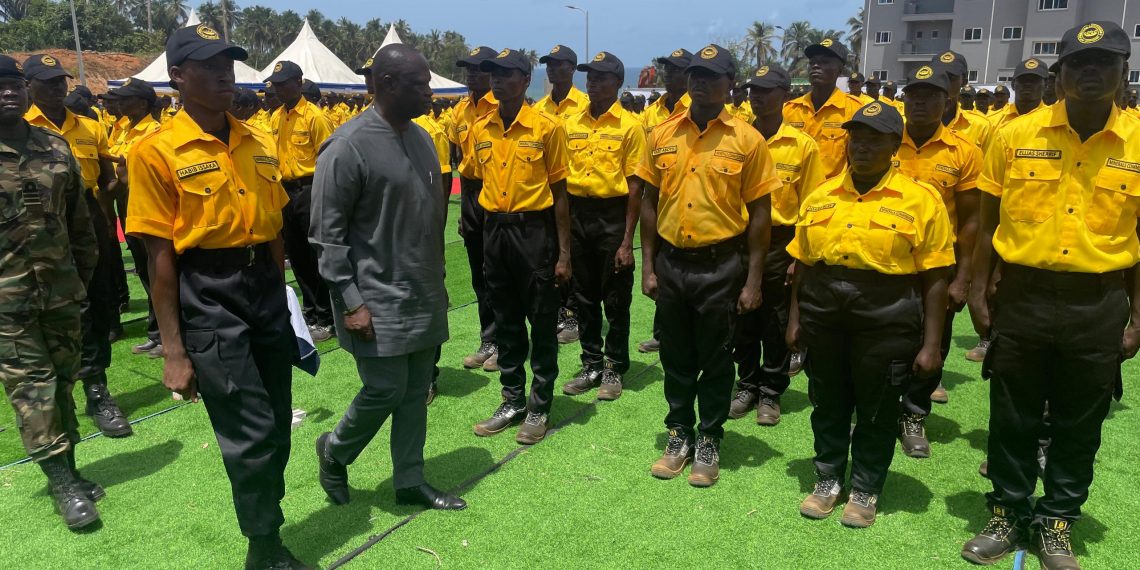
In a bold step toward securing Ghana’s natural water resources, the government has officially completed the first deployment phase under its Blue Water Initiative, aimed at curbing illegal mining and restoring polluted river systems across the country.
A contingent of 453 trained personnel, dubbed Blue Water Guards, graduated after completing four weeks of rigorous training at the Ghana Navy Forward Base in Ezilibo, located in the Western Region’s Jomoro District.
Their graduation marks a significant milestone in the broader vision to deploy 2,000 guards nationwide, as part of a collaborative national security and environmental protection initiative spearheaded by the Ministry of Lands and Natural Resources.
The training regimen combined theoretical, physical, and hands-on practical modules, equipping the recruits with the skills to operate in challenging terrains and to assist the Ghana Navy in defending Ghana’s major river bodies from the destructive impact of illegal small-scale mining, popularly known as galamsey.
Within a week, these guards will be dispatched to key hotspots along the Ankobra, Pra, Tano, Fia, and Bonsa rivers—waterways that have suffered extensive degradation from mining pollution.
To ensure operational efficiency, five Naval Operational Bases have been established to provide real-time surveillance, logistics, and rapid response support to the guards on the ground.
Launched on March 17, 2025, the Blue Water Initiative is not just a law enforcement program—it is a strategic environmental intervention, reflecting the government’s urgency in confronting the environmental crisis brought on by unregulated mining.
Officials say the goal is to implement 24/7 monitoring of Ghana’s river systems, prevent further ecological damage, and ultimately reclaim water bodies for public and agricultural use.
Environmentalists have hailed the initiative as a long-overdue response to the galamsey menace, though they caution that its success will depend on sustained political will, transparency, and collaboration with local communities.






