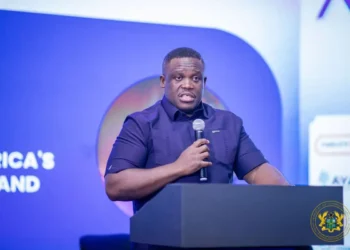
The Government of Ghana has announced plans to develop a one-stop Data Exchange Hub aimed at enhancing Artificial Intelligence (AI) innovation and national development.
The initiative was unveiled by the Minister for Communication, Digital Technology, and Innovations, Samuel Nartey George, in a speech delivered on his behalf by Dr. Collins Yeboah-Afari, CEO of the Kofi Annan ICT Centre, at the maiden Ghana AI Summit and Awards in Accra.
The summit, organized by Knowledge Innovations in collaboration with Deloitte Ghana, focused on the theme “Harnessing Artificial Intelligence for Sustainable Development: Hype or Reality?” and featured top AI experts discussing the future of AI in Africa.
According to the Minister, Ghana has vast amounts of data across industries, but its fragmentation limits its full potential. Large institutions generate significant data, yet much of it remains underutilized due to the lack of a unified system.
“To address this, we are developing a centralized Data Exchange Hub that will unify Ghana’s scattered data resources,” he said. “This platform will serve as the foundation for the country’s AI-driven future, enabling seamless data access for businesses, researchers, and decision-makers.”
The hub is expected to streamline governance, provide real-time insights for policy decisions, and enhance AI adoption across various sectors, from healthcare to agriculture.
In addition to the Data Exchange Hub, the government plans to digitalize over 100 billion physical records across hospitals, universities, and public institutions over the next four years.
This digitalization effort will ensure structured, anonymized, and secure data, aligning with global data governance standards to support AI-driven innovation.
The Minister also highlighted the need for home-grown AI models, explaining that Western AI models are often ineffective in addressing Africa’s unique challenges.
“We are developing AI language models tailored to Ghanaian and African contexts,” he said. “These models will be voice-based, enabling AI to communicate in local languages, ensuring accessibility for all citizens, including farmers and fisherfolk who can neither read English nor their native dialects.”
The AI models will be designed to support precision farming, weather forecasting, market insights, and resource management, particularly benefiting rural communities.
To ensure AI innovation aligns with national priorities, the Minister has directed a review of Ghana’s National AI Strategy (2023-2033) and all relevant technology sector laws.
The review will focus on:
✅ Data governance
✅ AI ethics and privacy protection
✅ Regulatory frameworks for fintech and digital platforms
“The review will ensure AI adoption is inclusive, ethical, and beneficial to all Ghanaians,” Sam George emphasized.
The government’s AI-driven initiatives, including the Data Exchange Hub, digitalization projects, and local AI models, are part of a broader strategy to position Ghana as Africa’s leading AI hub.
With proper regulatory frameworks and inclusive AI solutions, Ghana aims to harness AI for sustainable development, ensuring digital transformation benefits all sectors of the economy.