
















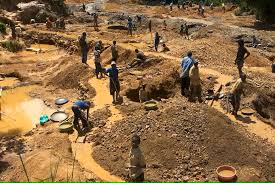
A new publication has urged Ghana to rethink its strategy in dealing with illegal mining, popularly known as galamsey, by adopting a more differentiated and sustainable approach rather than relying solely on periodic enforcement crackdowns.
The book, titled The Last Dig: How Beijing Changed the Galamsey Story to Model Mining, was launched in Accra by Mr. Yaw Amoyaw-Osei, Founder and Executive Chairman of the Centre for Environment and Health Research and Training (CEHRT).
The author argues that illegal mining in Ghana is a complex phenomenon that requires a nuanced response that separates organised criminal operations from poverty-driven artisanal mining activities.
Speaking to journalists after the launch, Mr. Amoyaw-Osei said the book aims to deepen public understanding of galamsey and provide practical policy recommendations for addressing its root causes.
He explained that while foreign-backed criminal mining networks responsible for large-scale environmental destruction must be completely eradicated, small-scale community miners should instead be supported through regulation and formalisation.
According to him, such a dual approach would help curb illegal operations while providing sustainable livelihoods for local miners who depend on the activity for survival.
Mr. Amoyaw-Osei stressed that the fight against galamsey should not be left to government alone, but must involve traditional authorities, district assemblies, security agencies and local communities.
He further called for stronger accountability measures, including sanctions for chiefs whose jurisdictions become hubs for illegal mining activities.
The author also proposed the election of Metropolitan, Municipal and District Chief Executives (MMDCEs), arguing that it would improve accountability in environmental governance, particularly at the local level.
He additionally recommended that police commanders be held responsible for illegal mining activities within their jurisdictions, and suggested the creation of District Environmental Task Forces to monitor and prevent illegal mining activities early.
Turning to environmental concerns beyond mining, Mr. Amoyaw-Osei questioned the effectiveness of flood control investments in Accra, citing the continued flooding despite major projects such as GARID.
He attributed recurring environmental challenges to weak enforcement of regulations, poor waste management and insufficient accountability within local government structures.
He stressed that Ghana already has enough research and policy frameworks to address both galamsey and flooding, but said the country’s main challenge remains implementation and enforcement rather than lack of solutions.






