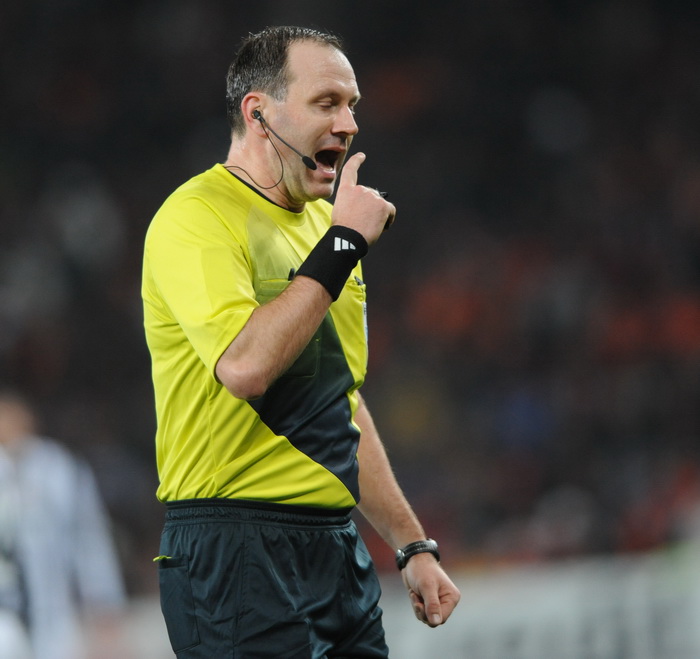
The air in the room was thick with the weight of unsaid things as Jonas Eriksson, a man who spent nearly two decades patrolling the high-stakes world of international football. Known during his career as the “millionaire referee” a nod to the success of his business ventures that shielded him from the financial pressures often exerted on officials Eriksson has always spoken his mind.
Today, however, he was addressing a fracture in the game that he believes goes far deeper than a single missed call.
The Inconsistency of Justice.
The conversation was anchored in a recent, glaring controversy: the disparate disciplinary fates of England’s Jarell Quansah and U.S. striker Folarin Balogun. To the public, these incidents were identical in nature, yet they resulted in drastically different punishments.
”I would love to have a good answer for you,” Eriksson admitted, his voice steady. “If you look at the Laws of the Game, ‘serious foul play’ like the incident involving the U.S. player, Folarin Balogun usually carries a two-match ban. He received only one, which I could accept, even though it should have been two. The same goes for the Quansah incident; it is typically a two-match ban, yet we saw the U.S. player’s suspension reduced to zero.”
For Eriksson, the lack of an appeals process isn’t just a procedural flaw; it is a mechanism of control.
The Collina Connection.
When Appiah pressed him on the perceived independence of FIFA’s disciplinary arm, Eriksson dismissed the notion as a fantasy. He pointed to a pattern that has defined football’s administration for nearly two decades: the symbiotic rise of Gianni Infantino and Pierluigi Collina.
”People claim the disciplinary department operates independently and that there is no influence from FIFA President Gianni Infantino, but that is nonsense,” Eriksson stated. He traced the timeline of their professional entanglement back to 2009, when Infantino, then serving as General Secretary of UEFA, brought Collina in as Chief Refereeing Officer. When Infantino ascended to the FIFA presidency, the appointment followed him to Zurich, with Collina installed as Chairman of the Referees Committee.”
A Culture of Collusion.
Eriksson described a relationship that transcends professional boundaries. The public displays of camaraderie the high-fives and the intimacy on the training grounds are, in his view, a public signal of a private reality.
”They spend personal time together; they have a very tight relationship,” he explained. “Of course there is a relationship; of course they are influencing decisions; of course they are influencing the appointment of referees, regardless of performance. The connection is undeniable, so it is simply not the case that the refereeing unit is 100% independent or that they are making their own decisions.”
A Career Defined by Integrity.
To understand why Eriksson’s voice carries such weight, one must look at the foundation of his career. Born in 1974, Eriksson became a FIFA-listed referee in 2002. Over an 18-year career that culminated in his retirement in 2018, he became a fixture of the global game.
He was a staple of the most grueling environments, officiating in the UEFA Champions League, the 2014 FIFA World Cup in Brazil, and both the 2012 and 2016 UEFA European Championships.
He famously oversaw the 2016 UEFA Europa League Final. Yet, it was his life outside the whistle that truly set him apart. Having sold his sports media company for millions, he was never a man who needed the game’s favor to secure his future.
That financial independence allowed him a rare commodity in the world of professional football: the ability to speak the truth without fear of losing his livelihood.
Now, as he reflects on the state of the game he served for nearly two decades, his message is clear: the institutions governing the sport are no longer just managing the game; they are dictating its narrative, and it is the integrity of the sport itself that hangs in the balance.
Filed by Vince Owusu Appiah
Journalist, UK