
















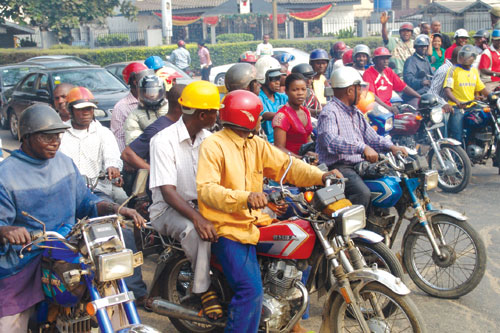
The Minister of Transport, Mr Joseph Bukari Nikpe, has placed the responsibility for the success of Ghana’s newly commercialised motorcycle, tricycle and quadricycle operations largely on riders, urging them to demonstrate that the policy can be implemented without a corresponding rise in road crashes and fatalities.
He said the legalisation of commercial motorcycle operations had generated significant public concern over road safety, but riders now had an opportunity to dispel those fears by showing discipline, professionalism and strict compliance with road traffic regulations.
“Let us impress Ghanaians. Let us prove to Ghanaians. Let us show Ghanaians that this Okada legalisation will not bring any bad news to anybody using our roads. Do not let us regret going to Parliament for this amendment,” Mr Nikpe said.
He was speaking in Accra on Tuesday at the launch of the “Safe Journey” Road Safety 2026 Campaign, organised by the National Road Safety Authority (NRSA) in partnership with Somoco Ghana Limited, a dealer in motorcycles, tricycles and quadricycles.
The campaign seeks to improve road-user behaviour, promote compliance with traffic regulations and contribute to a sustained reduction in road crashes, injuries and deaths, with particular attention to the growing number of motorcycle and tricycle riders.
Mr Nikpe said the government recognised the important role of motorcycles and other forms of intermediate transport in providing mobility, particularly to communities and areas where conventional public transport services were inadequate.
He said commercial motorcycles, tricycles and quadricycles provided essential last-mile connectivity while supporting livelihoods, businesses and employment, making their formalisation an important part of efforts to address Ghana’s transportation challenges.
However, the Minister stressed that the economic and mobility benefits of the policy could only be sustained if operators demonstrated that they could use the roads responsibly.
He said amendments to the Road Traffic Regulations had consequently placed obligations on the Ministry of Transport and its agencies to undertake public education, awareness creation, rider training and insurance arrangements to ensure that the new regime operated within the law.
Mr Nikpe said the Ministry had engaged stakeholders and members of the public who expressed reservations about the commercialisation of motorcycles because of concerns over crashes and fatalities.
He therefore urged riders to regard road safety as a condition for the long-term success of the policy and to respect traffic signs, other road users and designated operational requirements.
The Minister cited Togo and Rwanda as examples where motorcycle riders had demonstrated greater compliance with road safety regulations. He said a Ghanaian delegation that visited Rwanda to study its road safety practices observed an orderly system in which motorcycle riders generally respected traffic regulations.
He said the government would continue working with the NRSA, Driver and Vehicle Licensing Authority (DVLA), Ghana Police Service and other relevant institutions to educate, sensitise and guide commercial riders.
The Director-General of the NRSA, Mr Abraham Amaliba, said the country’s road safety challenge required collective action, warning that enforcement alone could not deliver sustainable reductions in road crashes.
He identified speeding, reckless overtaking, riding without appropriate protective equipment, disregarding traffic signals, riding under the influence of alcohol or drugs and the improper carrying of passengers among behaviours that could have fatal consequences.
Mr Amaliba said no passenger, delivery or journey was important enough to justify a rider risking his or her life through dangerous driving or disregard for traffic regulations.
He said the “Safe Journey” campaign would therefore focus on nationwide education, stakeholder collaboration and community engagement, with the NRSA seeking the active participation of the Transport Ministry, Police Service, DVLA, local authorities, transport unions, rider associations, traditional leaders, civil society organisations, the private sector and the media.
For Somoco Ghana Limited, the campaign represents an effort to ensure that road safety becomes an integral part of the motorcycle and tricycle business rather than an issue addressed only after crashes occur.
The company’s Managing Director, Mr Nii Ayi Hyde, said the company had a responsibility to promote safety because its operations contributed to placing thousands of motorcycles and tricycles on Ghana’s roads.
He said it was not sufficient for dealers to provide vehicles that were efficient and commercially useful, stressing that safety must be incorporated into the entire process—from the point of sale to the final journey.
Mr Hyde said Somoco, in partnership with the NRSA, would support practical interventions including rider training, licensing assistance, promotion of helmets and protective equipment, safety education at the point of sale and continued safety messaging at Okada stations, delivery routes and communities.
He urged riders to wear helmets, observe approved routes and prioritise the safety of passengers.
Representatives of motorcycle rider associations welcomed the initiative and pledged to support efforts to make the commercialisation of motorcycle and tricycle operations compatible with improved road safety.
They urged their members to take the campaign seriously and demonstrate through responsible conduct that the legalisation of commercial motorcycle operations could coexist with safer roads.






