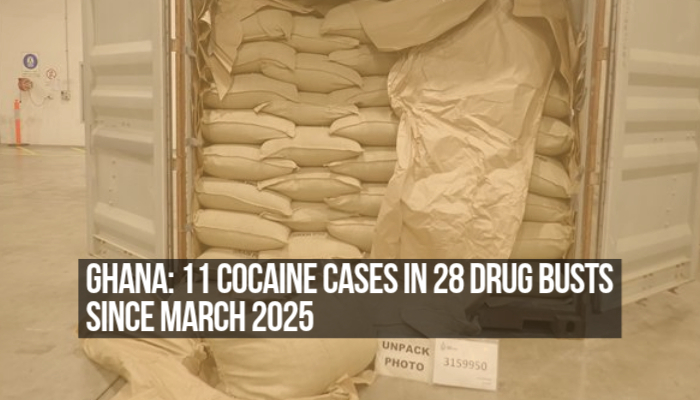
International drug seizures linked to Ghana have raised fresh questions about the country’s role in the cocaine supply chain, with seizures made abroad accounting for far larger quantities than those intercepted on Ghanaian soil since March 2025.
A JoyNews Research tally covering March 2025 to September 22, 2026 recorded 28 major drug busts, including 11 cocaine cases. Seven of the cocaine seizures occurred in Ghana, while four were made in Europe after consignments had left the country.
Although fewer in number, the four foreign cocaine seizures accounted for about 12.4 tonnes, compared with approximately 3.6 tonnes seized in Ghana in cases where the weights were made public.
The figures mean that for every kilogramme of Ghana-linked cocaine intercepted domestically, more than three kilogrammes were stopped by foreign authorities.
The biggest overseas seizure was recorded in June 2025, when Dutch authorities intercepted nearly 4.5 tonnes of cocaine concealed in a timber shipment from Ghana at the Port of Amsterdam. It was described as the largest cocaine seizure ever recorded at the port.
Belgian authorities subsequently intercepted 2,829 kilogrammes of cocaine concealed in cassava flour shipped from Tema at the Port of Antwerp in November 2025. Another 1,158 kilogrammes was seized in December in a separate shipment from Ghana.
The pattern continued in September 2026 when French customs seized almost 3.9 tonnes of cocaine from a container of plastic waste that had arrived at Dunkirk from Ghana. The consignment was valued at about €225 million, or US$261 million.
The Dunkirk seizure has particularly intensified scrutiny of Ghana’s export-control and port-security systems because of the quantity involved and the fact that the cocaine was concealed in a commercial container.
Ghanaian authorities subsequently arrested suspects in connection with the shipment, while four Ghanaians were later arraigned before the High Court in Accra on charges relating to the alleged exportation of the cocaine.
The country’s domestic seizures, however, also show the scale of the challenge.
The largest recorded seizure in Ghana in the period under review occurred at Pedu Junction in Cape Coast in March 2025, where more than 3.3 tonnes of cocaine was reportedly found concealed beneath sand in a tipper truck.
Other interceptions have occurred at Kotoka International Airport and around the Tema port area, including an August 2026 operation in which 866 parcels concealed in gari sacks were intercepted.
The trafficking pattern also extends beyond cocaine. Australian authorities seized 320 kilogrammes of methamphetamine concealed in charcoal shipped from Ghana in 2026, while other Ghana-linked cases have involved cannabis, heroin and pharmaceutical opioids.
The international seizures have placed renewed attention on Ghana’s position within global drug-trafficking routes.
Figures released by Belgium’s Federal Finance Department showed that Ghana ranked fifth among countries of origin for cocaine seized at the Port of Antwerp in 2025. In customs terminology, the designation refers to the country where the container was loaded, not necessarily where the cocaine was produced. The drugs linked to Ghanaian shipments are understood to originate from South America and to have been concealed in legitimate exports.
The developments have also prompted changes in Ghana’s response.
Following the Dunkirk seizure, President John Mahama directed an inter-agency task force to develop measures to prevent narcotics from passing through Ghana’s borders and asked port agencies to establish a common operational framework.
The government also restored the Narcotics Control Commission (NACOC) to joint container inspections at the ports, after the Commission had previously been excluded from that role.
NACOC has maintained that it is strengthening cooperation with international law-enforcement agencies to disrupt trafficking networks operating through Ghana and has begun investigations into the individuals and systems connected to major seizures.
The emerging picture is therefore not limited to the quantity of drugs intercepted in Ghana. The much larger volumes stopped in European ports have shifted attention towards how narcotics are being concealed in legitimate Ghanaian exports, how shipments pass through the country’s ports and whether existing detection and intelligence systems are sufficient to prevent them from leaving the country.