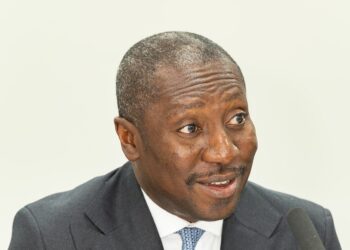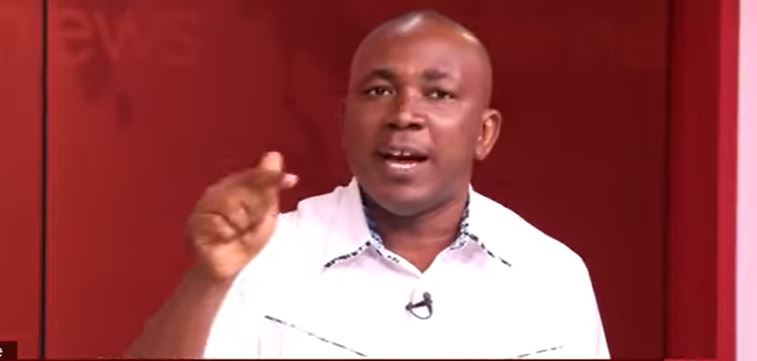
Professor of Finance at the University of Ghana Business School, Prof. Godfred Bokpin, has challenged the government to go after influential individuals behind illegal mining, arguing that the continued focus on low-level operators is shielding the powerful networks responsible for the destruction of Ghana’s environment.
He maintained that the fight against illegal mining, popularly known as galamsey, would remain ineffective unless the State demonstrated the political will to confront individuals with the financial and political influence to sustain the operations.
Speaking on JoyNews’ Newsfile on Saturday, October 31, 2026, Prof. Bokpin accused successive failures of leadership and political interference of allowing illegal mining to expand, despite repeated government assurances to tackle the menace.
He questioned how individuals with limited financial resources could independently acquire and operate sophisticated mining equipment, including changfans, without the support of powerful financiers and influential backers.
“We are using JSS school dropouts as a face shield. We know those who are behind this,” he stated.
According to him, the tendency to portray junior high school dropouts as the principal faces of illegal mining diverts attention from the influential individuals and networks that finance, facilitate and benefit from the activity.
Prof. Bokpin argued that although illegal mining had existed in Ghana for decades, its scale and destructive impact had increased significantly, particularly with the growing involvement of politically connected individuals.
He consequently questioned the State’s apparent inability to confront those behind the operations, insisting that the problem reflected a deeper crisis of leadership and accountability.
Drawing on the biblical account in Judges 21:25, which describes a situation where everyone did what was right in their own eyes because there was no king in Israel, the economist said Ghana’s galamsey situation had reached a similar point.
“In this galamsey, there is no leadership. Everybody is doing as they see fit in their eyes,” he observed.
He further reminded the government that the 1992 Constitution places Ghana’s natural resources under the authority of the President, who holds them in trust for the people.
Against this background, he questioned why the State had failed to adequately protect the country’s natural resources and ecological systems despite its constitutional responsibility.
The economist also linked the galamsey crisis to Ghana’s broader economic management, warning that environmental destruction could undermine the foundations upon which sustainable economic growth depends.
He argued that government efforts to stabilise the economy would amount to little if the country’s water bodies, forests and other critical ecological assets continued to suffer extensive destruction.
“Mr President, you cannot talk about managing an economy when the very foundation of this economy, being the environment, the ecological integrity, is being compromised,” he said.
Prof. Bokpin expressed concern that the consequences of environmental degradation could extend beyond the current generation, leaving future generations to bear the cost of the country’s failure to protect its natural resources.
He called for stronger political leadership, decisive enforcement and accountability, insisting that the fight against illegal mining must move beyond arresting low-level operators to identifying and confronting the influential individuals sustaining the illegal trade.
His comments add to growing concerns over the effectiveness of Ghana’s anti-galamsey campaign and the need to hold financiers, politically connected actors and other powerful beneficiaries accountable.