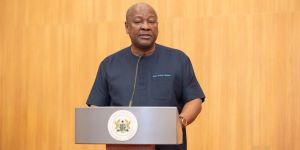
President John Dramani Mahama has charged four newly sworn-in Ghanaian ambassadors to make the protection of citizens abroad, investment mobilisation and job creation central to their diplomatic assignments, as his administration seeks to align foreign relations with national economic priorities.
He said the effectiveness of Ghana’s diplomatic missions must be measured by their ability to attract investment, expand markets for Ghanaian businesses and establish partnerships that create tangible economic opportunities for the country.
The President gave the directive at the swearing-in ceremony of the four envoys at the Jubilee House on Friday, October 16, 2026, urging them to align their activities with the government’s Reset Agenda.
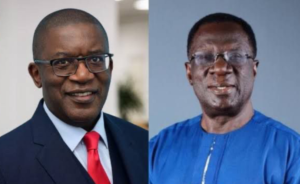
The newly appointed ambassadors are Nana Antwiwaa Dodoo, assigned to Angola; Louis Kwame Obeng, assigned to Qatar; Evelyn Korantemaa Ofosu-Amable, assigned to Israel; and Jedidiah Reuben Adogla, Ghana’s Permanent Representative to the United Nations Office in Geneva, Switzerland.
President Mahama said the ambassadors had a responsibility to ensure that Ghana’s international relationships translated into measurable improvements in the country’s economic prospects and the welfare of its citizens.
“Our missions play an important role in identifying investors whose interests align with Ghana’s development priorities, helping Ghanaian businesses enter new markets abroad, and building relationships with institutions that can support skills development, research, and technology transfer,” he said.
Economic diplomacy takes centre stage
President Mahama urged the envoys to identify investment opportunities that support Ghana’s industrialisation agenda and help local businesses compete in international markets.
He said diplomatic engagements should go beyond maintaining bilateral relations to securing partnerships that strengthen domestic production, facilitate technology transfer and create sustainable employment.
The ambassadors were also tasked with helping Ghana retain greater value from its natural resources by attracting investment into local processing and other productive industries.
The President stressed that the country’s natural resources should serve as a foundation for industrial growth rather than remain predominantly sources of raw material exports.
He further urged the envoys to work closely with the Ministry of Foreign Affairs and other relevant government institutions to ensure that their activities reflected national development priorities.
Welfare of Ghanaians abroad
Beyond economic diplomacy, President Mahama emphasised the need for efficient consular services and stronger support for Ghanaians living and working abroad.
He said the welfare of citizens must remain a priority for diplomatic missions, requiring the ambassadors to respond effectively to their concerns and protect their interests in their respective host countries.
The President also reminded the envoys to use public resources responsibly and conduct themselves in accordance with government policy and the constitutional principles governing Ghana’s international relations.
He cited Article 40 of the 1992 Constitution as a key guide to promoting and protecting the country’s interests abroad.
BRICS partnership to broaden opportunities
President Mahama also highlighted Ghana’s application for partnership with BRICS, describing the initiative as part of a broader strategy to diversify the country’s development partners and deepen cooperation among developing economies.
He said the engagement was intended to expand opportunities for trade, investment, industrialisation and value addition without undermining Ghana’s longstanding relationships with traditional partners.
The President urged the ambassadors to explore opportunities arising from Ghana’s international partnerships and ensure that these engagements contributed to the country’s economic transformation.
Mahama reaffirms Ghana’s position on Palestine
The President gave a specific directive to Evelyn Korantemaa Ofosu-Amable, Ghana’s new ambassador to Israel, urging her to uphold the country’s position on the Israeli-Palestinian conflict.
He reaffirmed Ghana’s recognition of the sovereign State of Palestine and support for a two-state solution that would allow Israel and Palestine to coexist peacefully within internationally recognised and secure borders.
“We recognise the sovereign State of Palestine and support a viable two-state solution in which Israel and Palestine will live side by side in peace and security within internationally recognised and secure borders,” President Mahama said.
He added that Ghana’s international engagements must uphold international law, protect civilians and respect human dignity.
The directive underscores the expectation that Ghana’s diplomatic missions must pursue economic interests while remaining consistent with the country’s established foreign policy positions.
President Mahama concluded by urging all four ambassadors to work in coordination with the Ministry of Foreign Affairs, protect Ghana’s national interests and ensure that their assignments produced meaningful benefits for the country and its citizens.