
















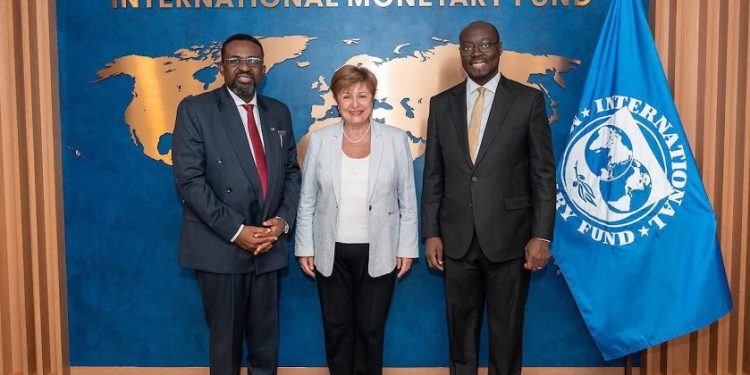
Ghana’s ability to sustain fiscal discipline, improve revenue mobilisation and manage public spending is expected to come under scrutiny as an International Monetary Fund (IMF) mission begins a two-week visit to assess the country’s economic performance and policy direction.
The mission, led by Dr Ruben Atoyan, is expected to engage officials of the Ministry of Finance and the Bank of Ghana on the government’s fiscal outturn for the first nine months of 2026 and the measures required to maintain economic stability.
The discussions come as the government prepares the 2027 Budget, with infrastructure investment expected to feature prominently in its spending priorities.
Sources familiar with the visit told JoyBusiness that the IMF team is expected to examine revenue performance, expenditure controls, Ghana’s debt position and the government’s spending plans for the remainder of the year and into 2027.
The mission is also expected to assess whether the government’s fiscal plans can support infrastructure development without undermining the gains made through recent economic reforms.
Monetary policy is another anticipated area of focus, particularly Ghana’s inflation-targeting framework, foreign exchange arrangements and the management of international reserves.
The financial position of the Bank of Ghana and measures to safeguard its independence are also expected to feature in the engagements.
Other key economic stakeholders are likely to join the discussions during the mission’s stay.
Shift from IMF financing to policy monitoring
The visit forms part of Ghana’s engagement with the IMF under the Policy Coordination Instrument (PCI), a non-financing arrangement designed to help countries consolidate economic gains and sustain reforms.
The IMF Executive Board completed the sixth and final review of Ghana’s Extended Credit Facility (ECF) programme on July 27, 2026, while considering the country’s request for a 36-month PCI.
Unlike the ECF, the PCI does not provide direct financial assistance. Instead, it allows the IMF to assess a country’s economic policies and progress in implementing agreed reforms, while providing a framework for maintaining confidence among investors and development partners.
The upcoming discussions will therefore provide an opportunity for Ghana to demonstrate that its economic management remains consistent with the objectives of the new programme.
2027 Budget under close scrutiny
The government’s revenue and expenditure plans for 2027 are expected to be important to the IMF’s assessment, particularly as authorities seek to balance infrastructure investment with the need to maintain fiscal stability.
Revenue mobilisation, expenditure management and debt sustainability will be central to determining whether planned spending can be accommodated without creating renewed fiscal pressures.
The discussions are also expected to consider the policy measures needed to sustain progress in macroeconomic stability, address underlying economic imbalances and strengthen the country’s resilience to external shocks.
Finance Minister Dr Cassiel Ato Forson has previously described the PCI as an anchor for Ghana’s next phase of economic reforms, aimed at preserving recent gains, strengthening policy credibility and supporting broad-based growth.
Maintaining investor confidence
The PCI is designed to provide a structured framework for economic policy coordination between Ghana and the IMF without the provision of direct funding.
Countries operating under the instrument are expected to meet policy standards comparable to those associated with IMF lending arrangements, with progress assessed through scheduled reviews, typically every six months.
The programme requires approval by the IMF Executive Board, distinguishing it from a Staff-Monitored Programme, which is an informal arrangement between a member country and IMF staff.
For Ghana, the effectiveness of the framework will depend on the government’s ability to translate its commitments into consistent fiscal and monetary policies.
The IMF mission’s findings are therefore expected to provide an important assessment of the country’s economic performance and the policy choices facing authorities as they prepare the 2027 Budget.






